How to Use This Glossary
Every entry gives you a clear definition plus the context that tells you when and where the term actually comes up. Each one has its own link, so you can point someone at a single definition rather than the whole page. Come back whenever you meet unfamiliar poker language in our guides, at the table, or in training content.
If you are completely new to poker, start with our introduction to poker and basic rules guide first, then use this glossary as a reference.
385 terms, A to Z. Every entry has its own link — use the letters above to jump, or your browser's find to search the page.
#
8-Game Mix
An eight-game rotation that adds deuce-to-seven triple draw, no-limit hold'em and pot-limit Omaha to the five HORSE games. Because it mixes fixed-limit, pot-limit and no-limit betting inside one session, both bankroll swings and bet-sizing decisions change sharply from one game to the next.
A
Acting Out of Turn
Betting, calling, checking or folding before the players to your right have acted. The premature action is binding if the situation is unchanged when the turn genuinely reaches you — an out-of-turn check stands if everyone before you also checks — but is voided if someone bets or raises first. Even when voided it leaks information, because opponents now know what you intended to do.
Action
Any decision a player makes at the table: check, bet, call, raise, or fold. "The action is on you" means it is your turn to act. Also used to describe a game with lots of betting and raising — a "high action" table.
Add-on
A one-time chip purchase offered to every remaining player at the end of the rebuy period, regardless of stack size. It usually gives more chips per dollar than a rebuy did — a $10 rebuy might buy 5,000 chips while the $10 add-on buys 7,500 — so most players intending to continue take it automatically.
Aggression Factor (AF)
A tracking statistic equal to bets plus raises divided by calls, measured after the flop. An AF of 1 means a player bets and raises as often as they call; below 1 is passive and 3 or higher is aggressive. It ignores folds entirely, so it is read alongside a folding statistic — a player who folds constantly but bets whenever they continue can show a high AF while being straightforward to play against.
All-in
Betting all of your remaining chips on a single hand. Once all-in, you cannot take any further action but remain eligible to win the pot up to the amount of your wager from each opponent. If other players continue betting, a side pot is created.
All-in Adjusted Winnings
A line on a tracking-software graph that replaces the actual result of each all-in with its expected value at the moment the chips went in. A player all-in with 70% equity is credited with 70% of the pot — $140 of a $200 pot — whatever the remaining cards do, rather than the $200 or nothing the board would have awarded. Comparing this line against actual winnings shows how the all-ins ran and nothing more: it removes all-in variance only, not the variance in every hand that never got there. Also called EV-adjusted winnings.
All-In Protection
A feature in some online and club games that treats a player who loses their connection as all-in for the chips already committed, so the hand runs to showdown instead of being folded. Where it is offered it is normally capped at a small number of uses per day to stop it being used deliberately, and many operators have removed it altogether. It never protects chips the player has not yet put into the pot.
Angle Shooting
Using technically legal but unethical maneuvers to gain an edge — ambiguous chip motions meant to induce a reaction, misstating a stack size, or acting out of turn on purpose. It falls short of outright cheating, but card rooms penalize it and it damages a player's standing in a game. Also called "shooting an angle."
Anonymous Tables
Tables where players are identified only by seat number, or by a name that changes each session, so hands cannot be linked to a specific opponent over time. They disable HUDs and player notes by design, and exist to stop recreational players from being tracked and seat-hunted. The trade-off is that nobody can research a table before sitting, so table selection largely disappears with them.
Ante
A forced bet that every player at the table must post before each hand. Antes are smaller than blinds and used in addition to blinds in tournaments (especially in later stages) and some cash game formats. They increase the pot size preflop and encourage more action.
Auto-Rebuy
A setting in an online client that automatically tops a stack back up whenever it falls below a chosen threshold — for example refilling to $200 any time the stack drops under $150. It exists so that a player does not end up playing a short stack by accident after losing a pot. The rebuy is applied between hands, like any other top-up.
B
Backdoor
A draw that requires both the turn and river cards to complete. For example, if you hold two hearts and one heart is on the flop, you have a backdoor flush draw — you need hearts on both the turn and river. Backdoor draws add a small amount of equity to your hand, typically 3-4%.
Bad Beat
Losing a hand in which you were a significant statistical favorite. For example, losing with pocket Aces when an opponent with 7-2 offsuit hits two pair on the river. Bad beats are a normal part of poker and happen to every player.
Bad Beat Jackpot (BBJ)
A promotional prize pool paid out when a very strong hand loses to an even stronger one. It is funded by an extra amount taken from qualifying raked pots, and the qualifying rules vary by game — a common requirement is that the losing hand be quad eights or better and that both players use both hole cards. The losing hand usually takes the largest share, the winner a smaller one, and the rest of the table splits what remains.
Badugi
A four-card draw game with three drawing rounds in which the object is the lowest hand made of four cards that are all different suits and all different ranks. A holding with a duplicate suit or rank counts only its best distinct cards, so a three-card badugi loses to any four-card badugi. Aces play low, making A-2-3-4 in four different suits the best possible hand — often called a perfect badugi.
Bankroll
The total amount of money you have set aside specifically for playing poker. Your bankroll should be separate from your personal finances. Proper bankroll management means only playing at stakes where your bankroll can absorb normal variance — typically 20-30 buy-ins for cash games and 50-100+ for tournaments.
Barrel
A bet on a postflop street, typically as a continuation of aggression. "Double barrel" means betting the flop and turn. "Triple barrel" means betting the flop, turn, and river. Each barrel puts increasing pressure on opponents to have a strong hand to continue.
bb/100 (Big Blinds per 100 Hands)
The standard cash-game win-rate unit — big blinds won per 100 hands — which makes results comparable across stakes and session lengths. A player winning 3 bb/100 in a $1/$2 game averages $6 per 100 hands. Because the swings are large relative to the edge, tens of thousands of hands are needed before the number means much.
Bet-fold
Betting with a plan to fold if raised. For example, value betting top pair on the river and folding to a large raise, because almost nothing worse would raise there. Deciding this before the chips go in prevents the common error of making a thin value bet and then paying off the raise that follows.
Big Blind (BB)
The larger of two forced bets posted before each hand. The big blind is placed by the player two seats to the left of the dealer button. It sets the minimum bet size for the preflop round. "BB" is also used as a standard unit of measurement for win rates and stack sizes (e.g., "I won 5 BB per 100 hands").
Big Blind Ante
A tournament format in which the player in the big blind posts the whole table's ante rather than every player posting a small one individually. It saves time by replacing eight or nine separate collections each hand with a single payment, usually equal to one big blind. Some rooms use a button ante instead, posted by the player on the button.
Big Slick
The nickname for ace-king, suited or offsuit. It is an unpaired hand that has to improve: against a lower pocket pair such as queens it is roughly a 43% underdog offsuit and about 46% suited. Its strength is that hitting the ace makes top pair with the best possible kicker, and hitting the king does the same on any board without an ace.
Bink
To win by hitting an unlikely card, as in binking a one-outer on the river. It is also used more loosely for winning a tournament, especially one entered cheaply — a player who takes down a large field is said to have binked it. Unlike suck out, the word carries no accusation of bad play; it is usually said with amusement.
Blank
A card that changes nothing — it completes no draw, pairs nothing meaningful and does not outrank the board. On J♥9♥4♠, a turned 2♣ is a blank, so whoever was ahead on the flop is still ahead. Also called a "brick," and a draw that misses is said to have "bricked."
Blind
A forced bet posted before cards are dealt. The two players to the left of the dealer button post the small blind and big blind. Blinds ensure there is always money in the pot to play for and rotate clockwise each hand so every player pays them equally over time.
Blind Defense
Calling or re-raising from the blinds against a late-position open instead of folding. The blind already posted counts toward the call, so the price is better than it is for any other seat — folding almost everything would let opponents raise profitably with any two cards. Facing a 2.5 big blind button open with the small blind folded, the big blind adds 1.5 big blinds to a 4 big blind pot and needs roughly 27% equity to break even, which is why big blind defending ranges are so wide.
Blind Level
The period during which one set of blinds and antes applies before the next increase. Level length defines a tournament's structure — long levels keep stacks deep in big blinds and reward postflop play, while short levels force all-in decisions sooner. Most events time levels by the clock, though some online formats count them in hands dealt instead.
Blind vs Blind (BvB)
A pot contested only by the small blind and the big blind after everyone else has folded. Ranges are much wider than in other spots because only one opponent remains and there is already dead money in the middle. The small blind acts first on every street here, preflop included, so they are out of position for the entire hand.
Blocker
A card in your hand that reduces the likelihood of an opponent holding a specific hand. For example, if you hold the Ace of spades on a board with three spades, you "block" the nut flush — your opponent cannot have it. Blockers are important in advanced bluffing decisions.
Blocker Bet
A small bet made out of position, usually on the river, to set a cheap price and discourage a bigger bet from the opponent. For example, betting $20 into a $100 pot with a medium-strength hand instead of checking and facing a $70 bet. Also called a blocking bet — the name refers to blocking the opponent's sizing, not to card-removal blockers.
Bluff
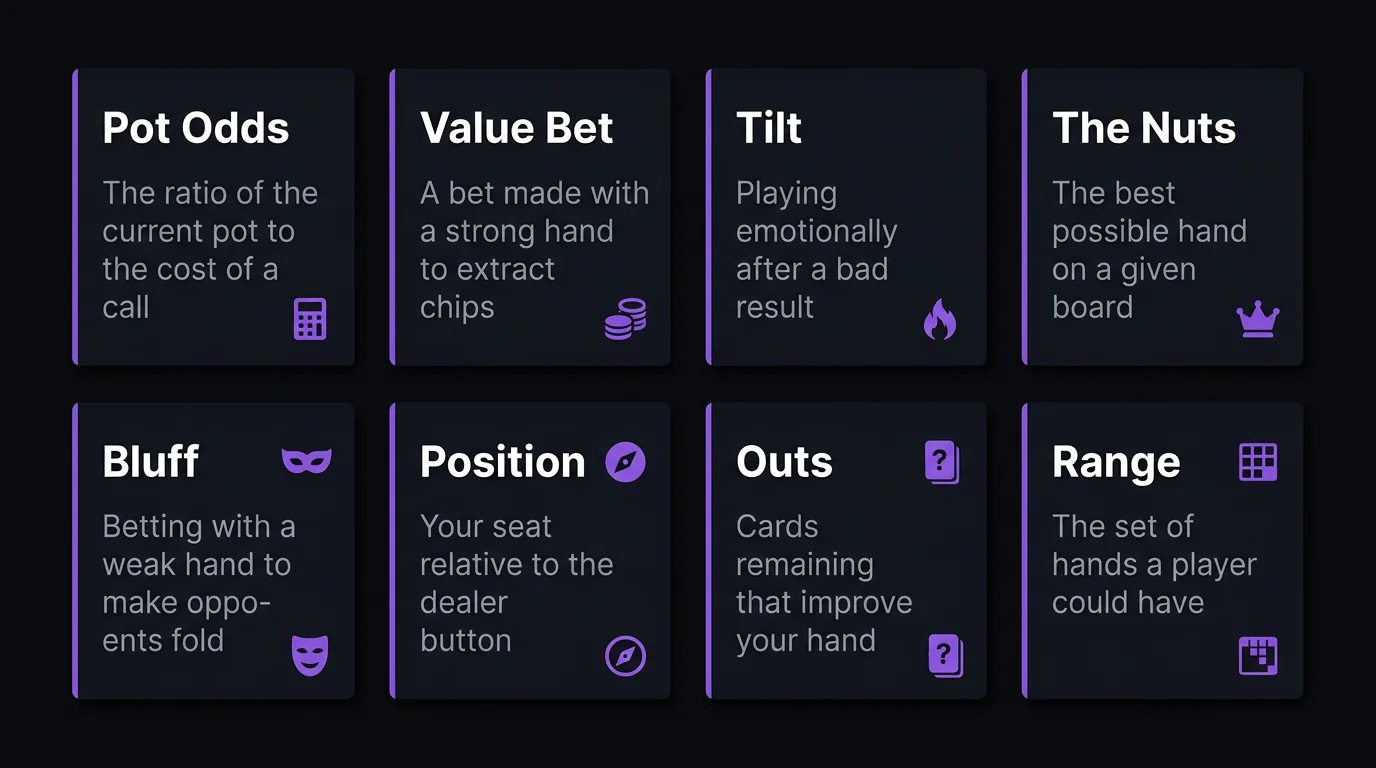
A bet or raise made with a weak hand, intended to make opponents fold stronger hands. Bluffing is a fundamental part of poker strategy — if you never bluff, opponents can safely fold whenever you bet. Learn more in our complete guide to bluffing.
Bluff-catcher
A hand strong enough to beat an opponent's bluffs but not strong enough to be bet for value, so its only purpose in calling is to catch a bluff. For example, holding A-Q on a board of K-8-4-2-J against an opponent who would only bet a king or better for value — the hand beats missed draws and nothing else. Calling with a bluff-catcher is a frequency decision: it is correct when the opponent bluffs more often than the pot odds require.
Bluff-to-Value Ratio
The proportion of bluffs to value hands in a betting range, set so the opponent cannot profit by always calling or always folding. On the river a pot-sized bet supports one bluff for every two value hands (33% bluffs), while a half-pot bet supports one for every three (25%). Larger bets allow more bluffs because they lay the caller worse odds to call.
Board
The community cards dealt face-up in the center of the table. In Hold'em, the board consists of up to five cards: three on the flop, one on the turn, and one on the river. Also called the "community board" or simply "the cards on the table."
Boat
Slang for a full house — a hand consisting of three of a kind plus a pair (e.g., three Kings and two Fives). A full house is the fourth strongest hand in standard poker rankings.
Bottom Pair
A pair made by matching the lowest card on the board — holding A-4 on a flop of K-9-4. It is the weakest of the three flop pairs, losing to both middle and top pair, so its value usually rests on the kicker or on improving to two pair or trips.
Bounty
A cash prize on each player's head, collected by whoever eliminates them, funded by splitting the buy-in. In a $100 bounty event, $50 might go to the prize pool and $50 becomes each entrant's bounty, so knocking someone out pays $50 immediately. Also called a knockout, or KO. Because the bounty is only paid to the player who actually ends the opponent's tournament, it justifies calling all-ins slightly wider against opponents you cover — beating a bigger stack wins the pot but no bounty, since that player is still in the event.
Break-even Percentage
The frequency at which a bet, bluff or call must work to show exactly zero profit — risk divided by risk plus reward. A $50 bluff into a $100 pot risks $50 to win $100, so it must succeed 50 ÷ 150 = 33% of the time to break even. Anything above that threshold is profitable over the long run; anything below it loses money.
Brick
A card that changes nothing — it completes no obvious draw and is unlikely to have improved anyone's hand. For example, the 2♣ arriving on a board of Q♥-J♥-8♠ when the betting suggests hearts and straight draws are out there. Also called a blank, and used as a verb: a player who misses a draw on both the turn and the river has bricked it.
Bring-in
The forced bet that opens the action in stud games, posted after the antes by the player showing the lowest up card — or the highest up card in razz, where high is bad. Suits break ties in the order clubs, diamonds, hearts, spades, so the 2♣ brings it in ahead of the 2♦. The bring-in is smaller than a full bet, and the player posting it may instead complete to the full small bet.
Broadway
The ace-high straight, A-K-Q-J-10 — the highest straight in poker, beaten only by a flush or better. The word also describes the cards themselves: any card from ten to ace is a broadway card, and a holding like K-J is a broadway hand.
Bubble
The stage just before the payouts begin, when the next player eliminated finishes with nothing. In a 100-entrant event paying the top 15, the bubble is the period while 16 players remain. Play typically slows here as short stacks try to survive into the money, which is exactly what makes it the most profitable stretch of the tournament for a large stack.
Bubble Factor
A tournament measure of how much more a lost chip costs than a won chip gains, derived from the Independent Chip Model. A bubble factor of 1.5 means busting costs one and a half times what doubling up gains, so a call needs considerably more equity than the raw pot odds suggest. It peaks near the money bubble and at final tables with steep pay jumps, and it is always 1.0 in a cash game.
Burn Card
The top card of the deck, discarded face down by the dealer before the flop, the turn, and the river. Burning protects the game against a marked, damaged or accidentally glimpsed top card influencing the next street. Three cards are burned in a completed hold'em hand, and they take no part in anyone's holding.
Button (BTN)
The dealer position, marked by a round disc. The button is the most advantageous position at the table because that player acts last in every postflop betting round. Being "on the button" means you have maximum positional advantage.
Buy-in
The amount of money required to enter a game. In cash games, the buy-in is the amount of chips you purchase (usually with a minimum and maximum limit). In tournaments, it is the fixed entry fee.
C
C-bet (Continuation Bet)
A bet made on the flop by the player who was the preflop aggressor (raiser). It "continues" the story of strength told by the preflop raise, regardless of whether the flop helped your hand. C-bets are a fundamental part of modern poker strategy.
Call
Matching the current bet to stay in the hand. If an opponent bets $10, calling means putting $10 into the pot. Calling gives you a chance to win at showdown but does not put pressure on opponents to fold.
Calling Station
A player who calls far too often and almost never bets or raises — a typical station might play 45% of hands while raising preflop only 5% of the time. Bluffing a calling station is close to worthless; the correct adjustment is to bet thinner for value and abandon bluffs almost entirely. The term is mildly disparaging.
Cap
The maximum number of raises allowed in a single betting round (in limit poker), or the maximum rake taken from a single pot. In capped games, there is a maximum buy-in amount that limits stack sizes.
Card Dead
Going a long stretch without being dealt a hand worth playing. It is an ordinary consequence of variance: a premium holding — pocket Aces, Kings or Queens, or Ace-King — is only about 2.6% of starting hands, roughly one in every 39 deals, so an hour or two without one at live speed is unremarkable. Genuinely unplayable stretches are shorter than they feel, since a normal opening range covers 15-25% of hands. The practical risk is behavioral: players who feel card dead tend to loosen their standards out of boredom and enter pots they would normally fold.
Card Protection
Placing a chip or a small object on top of your hole cards so they cannot be swept up by the dealer or fouled by another player's discards. The responsibility sits with the player rather than the dealer — a hand that touches the muck is ruled dead even when the mistake was not the player's own. Also called protecting your hand.
Card Removal
The effect that known cards — your own hole cards and the board — have on how many combinations of each hand an opponent can still hold. Holding one ace cuts an opponent's pocket aces from 6 combinations to 3, and their A-K from 16 to 12. A single card producing that effect is called a blocker; card removal is the combination counting behind it.
Cards Speak
The rule that a hand tabled at showdown is worth exactly what the cards show, regardless of how the player describes it. A player who turns over a flush and announces "just a pair" still wins with the flush — reading the hands is the dealer's job. It protects inexperienced players from losing a pot to a misstatement, though deliberately miscalling a hand to make an opponent muck can draw a penalty.
Cash Game (Ring Game)
A poker game in which the chips represent real money at all times and can be cashed out whenever a player chooses — unlike a tournament, where chips have no cash value and play continues until one player holds them all. Blinds stay fixed and players join and leave between hands. Under table stakes the stack in front of a player is the most they can lose on a single deal, and the most they can win from any one opponent — in a multiway pot each opponent can be matched for that amount, and a bigger stack's excess goes to a side pot. Also called a ring game.
Chase
To keep calling bets in pursuit of a draw, usually with the implication that the price is wrong. Calling a pot-sized bet on the turn requires winning about 33% of the time to break even, while a gutshot completes on the river only about 9% of the time (4 outs among 46 unseen cards) — that gap is what makes chasing a losing habit. Chasing with a draw that does have the odds is simply a call.
Check
Passing the action to the next player without betting. You can only check if no one has bet before you in the current round. Checking keeps you in the hand without committing additional chips.
Check Behind
Checking in position after every opponent has checked, which ends the betting on that street. It suits medium hands that want a cheaper showdown and strong hands that gain more by letting an opponent catch up or bluff later. Checking behind on the flop is also what sets up a delayed c-bet on the turn.
Check-call
Checking with the intention of calling a bet rather than betting the hand. It keeps an opponent's bluffs in the pot and holds the pot size down with medium-strength hands — for example, checking top pair with a weak kicker out of position and calling one bet. The cost is that the opponent can check behind and take a free card.
Check-raise
Checking when it is your turn, then raising after an opponent bets. A check-raise is a powerful move that traps opponents who bet with medium-strength hands. It can be used for value (with a strong hand) or as a bluff.
Chip
A token representing money in a poker game. In cash games, chips have direct monetary value. In tournaments, chips represent tournament equity but do not have a fixed dollar value.
Chip Dumping
Deliberately losing chips to a specific player through obviously bad calls, bets or folds in order to transfer a stack. It is used to move money between accounts, to launder funds, or to build one player a large stack late in a tournament. It is a form of collusion, and it is detected by reviewing the betting patterns between the same two players across many hands.
Chip Leader
The player holding the most chips at a given moment, either at one table or across the whole field. A chip lead is leverage rather than money — chips only convert to prizes at the end — but it lets the leader apply pressure that covered opponents cannot afford to call off against, especially near the bubble.
Chop
An agreement to split prize money, usually made heads-up or at the final table when the players prefer a guaranteed division to the variance of playing on. The word is also used for a split pot when two players hold identical hands — for example, both playing the board — and, in cash games, for returning the blinds when everyone folds to them. Also called chopping it up.
Chop the Blinds
A cash-game convention in which the small blind and big blind, when everyone else folds, agree to take their blinds back and move on to the next hand instead of playing it out. Both players have to agree, and house rules decide whether it is permitted at all. Chopping the blinds is never allowed in tournaments, where every chip must stay in play.
Coin Flip
An all-in confrontation in which both hands have close to 50% equity, most often a pocket pair against two higher unpaired cards. Pocket eights against A-K offsuit is roughly 55% to 45% for the pair — close enough that the name sticks. Also called a race, and it decides a large share of tournament outcomes because short stacks are forced to commit.
Cold Call
Calling a raise with no money already invested in the pot on that street. If one player opens to 3 big blinds and the button calls, that is a cold call — the big blind calling the same raise is not, because the blind is already posted. Cold-calling ranges are tighter than the blinds' calling ranges because the price is worse and players still to act can squeeze. A flat call is not the same thing: it means calling rather than raising, from any seat.
Cold Deck
A run of hands in which a strong holding keeps meeting a stronger one, so losing chips is close to unavoidable. The phrase comes from cheating — a cold deck was a pre-arranged deck secretly swapped into the game — and it survives as slang for a session where the cards are relentlessly unkind. A single hand of that kind is more precisely called a cooler.
Collusion
Two or more players secretly cooperating against the rest of the table — sharing hole card information, trapping an opponent between coordinated raises, or agreeing to share winnings. This is cheating rather than an etiquette problem, and confirmed cases normally end in account closure and confiscated funds. It is one of the hardest forms of cheating to catch, because any single hand can look ordinary; it usually surfaces only when hand histories, timing patterns and account data for the same group of players are reviewed together.
Color Up
The removal of the smallest chip denomination from play as blinds rise, with players exchanging those chips for larger ones. Leftover odd chips are settled by a chip race — the dealer deals one card for each odd chip a player holds, and the highest cards receive the higher-denomination chips. Standard rules prevent elimination by a chip race: a player who loses the race is given one chip of the new smallest denomination.
Combinatorics
The counting of how many specific two-card combinations a holding can be dealt as, used to weigh how likely an opponent has one hand versus another. Every unpaired hand has 16 combinations — 12 offsuit and 4 suited — while every pocket pair has 6. Comparing combo counts is how a player judges whether a range contains more value hands or more bluffs. Commonly shortened to "combos."
Combo Draw
A hand holding two draws at once, usually a flush draw together with a straight draw. For example, 9♥8♥ on a board of 7♥6♣2♥ has nine flush outs plus six further straight outs — fifteen in total, which get there about 54% of the time by the river. A draw that size runs close to even against a made one-pair hand.
Community Cards
Cards dealt face-up in the center of the table that all players can use to make their hand. In Hold'em, there are five community cards. In Omaha, there are also five, but players must use exactly three of them.
Connected Board
A board whose ranks sit close enough together to make straights, such as 9-8-7 or J-10-8. The tighter the connection, the more two-card combinations already hold a straight or an open-ended draw. A flop like K-8-3 is disconnected — no hand can hold a made straight or an open-ended draw on it, only backdoor possibilities.
Connectors
Two hole cards of consecutive rank, such as 9-8 or J-10. Their value is straight potential — a middling connector can complete four different straights, more than any gapped holding of the same ranks. A-2 counts as a connector because the ace plays low in the five-high straight.
Cooler
A hand where two or more players have very strong hands and significant action is unavoidable. For example: your pocket Kings vs an opponent's pocket Aces. Coolers are not the result of bad play — they are situations where big losses are virtually guaranteed regardless of skill.
Counterfeit
When a community card devalues a made hand by putting a better pair on the board, so one of your hole cards stops counting. For example, you hold K-5 on a flop of K-5-8 for two pair, and the turn is another eight — the board's eights now outrank your fives, so you and an opponent holding A-K both play kings and eights, and their ace kicker takes the pot you were ahead in.
Cowboys
The nickname for pocket kings (K-K), the second-best starting hand. Their main weakness is an ace on the flop, which happens about 22.6% of the time — any opponent holding an ace then has top pair. Also called King Kong.
Cutoff (CO)
The seat directly to the right of the button. The cutoff is the second-best position at the table and allows a wide range of opening hands because only one player (the button) has position on you postflop.
D
Dangler
A card in an Omaha starting hand that does not work with the other three, such as the deuce in J-T-9-2. It effectively reduces a four-card hand to a three-card one, because the six two-card combinations Omaha runs on shrink to the three that exclude the useless card. A dangler is the most common reason a hand that looks playable is not.
Dead Button
A rule for moving the dealer button when a player leaves the table: the big blind always advances one position, to the next active player, and the button — and sometimes the small blind — is placed in front of an empty seat rather than skipping anyone's blinds. A hand played this way can have no small blind posted at all; that position is dead for the hand. The rule exists so that no player pays the big blind twice or dodges it by standing up at the right moment.
Dead Hand
A hand that is no longer eligible to win the pot, no matter how strong it is. Hands are ruled dead when they are folded, when they touch the discards, when they contain the wrong number of cards, or when a player breaks a rule that carries that penalty. Chips a dead hand has already committed stay in the pot.
Dead Money
Chips in the pot from players who have already folded, or from blinds and antes. Dead money makes pots more attractive to win and can justify wider stealing ranges.
Dealer
The person who deals the cards. In a casino, a professional dealer handles the cards while a button marks the nominal dealer position for determining blind order. In home games, players often take turns dealing.
Deep Stack
A stack much larger than the standard 100 big blinds, usually taken to mean 200 big blinds or more. Deep stacks raise the value of hands that can make the nuts — suited connectors and small pocket pairs — and lower the value of one-pair hands, because there is enough money behind for a post-flop mistake to cost a full buy-in or more. The opposite of a short stack.
Degen
Short for degenerate — a player who gambles well past sensible limits, plays stakes outside their bankroll, or takes action for its own sake rather than for an edge. It is often used jokingly or self-deprecatingly among players, but the behavior it describes (chasing losses, playing to feel action) is a recognized sign of gambling harm rather than a style of play. Used about another player it is disparaging.
Delayed C-bet
A turn bet made by the preflop raiser after checking the flop. Checking back a flop that misses the raiser's range and then betting the turn when the opponent checks again attacks the many hands that are willing to check twice. It also protects the flop checking range, because strong hands are checked back there often enough to make the delayed bet credible.
Deuce-to-Seven Triple Draw (2-7)
A five-card lowball game with three draws and four betting rounds, played under deuce-to-seven ranking — the ace is always high, and straights and flushes count against the hand. The best possible holding is 7-5-4-3-2 in at least two suits. It is normally spread fixed-limit and appears in most mixed-game rotations.
Disconnect Protection
A rule that shielded a player who lost their connection mid-hand, historically by treating them as all-in for the chips already committed and putting the rest into a side pot. Almost every modern site has removed it because it was deliberately abused, and now simply lets the disconnected player's clock and time bank run down. In tournaments the absent player is blinded off rather than removed from the table.
Discounted Outs
Outs counted at less than full value because they may hand a better hand to an opponent. For example, J♦10♦ on a flop of 9♥8♥2♣ has eight straight outs, but the 7♥ and Q♥ put a third heart out and complete a flush for anyone holding two hearts, so those two cards should be discounted or dropped entirely. Honest out counting subtracts the cards that win the pot for someone else.
Dominated
A hand that shares a card with a stronger hand and therefore wins far less often than the raw card ranks suggest. A-Q against A-K is the classic case — the shared Ace is worth nothing to the weaker hand, which wins only about 24% of the time (with a further 4% or so split) and usually needs to pair its Queen. Weak aces and weak kings — A-J, A-T, K-Q, K-J — are the hands most often dominated when they call a raise. A small pair facing a bigger pair is not domination in this sense: the two hands share no card, and the small pair is simply a heavy underdog at around 18%.
Dominated Draw
A draw that loses a large pot a meaningful share of the time it actually completes, because a better version of the same hand is available to opponents. Holding 8♠5♠ on a board of K♠9♠2♦ is a flush draw, but when a third spade lands, any opponent holding two higher spades — A♠ or Q♠ with a second spade, and plenty of holdings in between — makes a bigger flush; if a fourth spade lands on the board, even a lone high spade beats you. Straight draws to the low end of a board are dominated the same way.
Dominated Hand
A hand that shares a rank with a stronger hand and is therefore a heavy underdog to it. A-J is dominated by A-K: pairing the ace helps both players and the king outkicks the jack, so A-J wins only about a quarter of the time. A small pocket pair against two overcards is not dominated — it is behind on nothing and simply racing, which is a different situation.
Domination
A situation where two hands share a card and one holds the better kicker, leaving the weaker hand very few ways to win. A-Q against A-K is dominated — it wins only about a quarter of the time, because pairing the ace does not help. Avoiding domination is the main reason strong players fold hands such as K-J and A-9 to early-position raises.
Donk Bet
A bet made out of position by a player who was not the preflop aggressor. For example, if you called a raise preflop from the big blind and then led out with a bet on the flop, that is a donk bet. The name comes from its association with inexperienced players, though donk bets have legitimate strategic applications.
Door Card
The face-up card each player receives on third street in stud games — the only card of theirs an opponent can see when the first betting round begins. Door cards decide who posts the bring-in and carry most of the early information in a hand: a player raising with a king showing is telling a very different story than one raising with a five.
Double Gutshot
A straight draw built from two separate inside draws, so two different ranks complete it — eight outs in total, the same as an open-ended draw. For example, holding 8-7 on a board of 5-9-J: a 6 makes 5-6-7-8-9 and a 10 makes 7-8-9-10-J. It is far better disguised than an open-ender because the cards that complete it sit inside the board rather than extending it. Also called a "double belly buster."
Double Up
Winning an all-in confrontation to double your stack. If you go all-in with $100 and win, you now have $200. "I doubled up" is one of the most satisfying phrases in poker.
Double-Suited
An Omaha starting hand containing two cards of one suit and two of another — A♠K♠J♥10♥ is double-suited. It can make either of two flushes, which is worth materially more than the same four ranks single-suited or rainbow. The term belongs to four-card games; a hold'em hand has only two cards, so it is simply suited or offsuit.
Downswing
An extended run of losses produced by normal variance rather than by bad play. Downswings of many buy-ins happen to winning players, which is why bankroll guidelines are set far above the buy-in of the game being played. The opposite stretch is an upswing, and it is just as much a product of variance.
Draw
A hand that is not yet complete but needs one or more cards to become a strong hand. A flush draw (four cards of the same suit) or a straight draw (four cards in sequence) are the most common. Drawing hands have potential but need to improve to win.
Drawing Dead
Holding a hand that cannot win no matter which cards come. For example, chasing a flush draw against an opponent who already has a full house — the flush arrives and still loses. A player is often drawing dead without knowing it, which is why the concept matters more when reviewing hands than at the table.
Drawing Thin
Continuing with very few outs, usually two or three. Two outs hit about 4% of the time on the next card and about 8% across the turn and river together, so calling a meaningful bet while drawing thin loses money in almost every case. It differs from drawing dead in that the hand can still win — just rarely enough that the price is almost never right.
Dry Board
A board offering few or no draws, typically rainbow and widely spaced, such as K♦7♠2♣. Very few hands connect with it, so equities are lopsided and a made hand rarely needs protection from later cards. Also called an "uncoordinated" board.
Ducks
The nickname for pocket deuces (2-2), the lowest pocket pair. Like any pocket pair, deuces flop three of a kind or better about 11.8% of the time — roughly one flop in eight — and that is essentially the whole hand, since a pair of twos rarely wins unimproved.
Dynamic Board
A board texture on which the winning hand is likely to change as the turn and river arrive. 9♠ 8♠ 5♦ is dynamic — about twenty of the forty-seven unseen cards complete a straight or a flush, so the hand that is ahead on the flop frequently is not ahead at showdown. Strong but vulnerable hands are usually bet rather than slow played on these textures.
E
Early Position (EP)
The first seats to act preflop at a full table — under the gun and the one or two seats after it. Early position players open the fewest hands, because almost the whole table still has the chance to raise behind them and, once the flop comes, they are out of position against every opponent except the blinds. A hand like A-J offsuit that is a comfortable open from the cutoff is usually a fold under the gun.
Effective Stack
The smaller of two stacks in a pot — the most that can actually be won or lost between those players. If one player has $300 and the other $80, the effective stack is $80, and every pot-odds, SPR and commitment calculation uses that figure rather than the larger stack. In a multiway pot the effective stack is different against each opponent.
Eight or Better
The qualifier used for the low half of split-pot games: a low hand must be five unpaired cards all ranked eight or lower, with the ace counting low. If no player qualifies, the high hand takes the whole pot. In Omaha hi-lo, where the low is built from exactly two hole cards and exactly three board cards, a board that never shows three cards of different ranks at eight or lower cannot produce a low at all, which turns the hand into a high-only game. In stud eight or better there is no board — each player makes a low from their own seven cards — so a low is available to anyone holding five unpaired cards eight or lower.
Equity
Your share of the pot based on the probability of winning the hand. If you have a 40% chance of winning a $100 pot, your equity is $40. Equity calculations are central to correct poker decision-making.
Equity Denial
The value a bet gains by folding out a hand that had real equity, so it never gets to realize its share of the pot. Betting top pair on a 9-5-2 flop partly gets worse pairs to call, and partly makes a hand like Q-J — two overcards with six outs, about 24% equity by the river — fold instead of seeing a free card. Equity denial is one of the main reasons to bet medium-strength hands that are not pure value.
Equity Realization
How much of a hand's raw equity a player actually converts into won chips by the end of the hand. A hand with 40% equity that is out of position and awkward to play may realize only 35%, while the same equity in position with a clear plan can realize more than its raw share. Position, initiative, stack depth and playability are the main drivers — often written as an R factor, where R = 1.0 means full realization.
Expected Value (EV)
The average amount you expect to win or lose on a particular play over the long run. A positive EV (+EV) play makes money over time; a negative EV (-EV) play loses money over time. Every poker decision should be evaluated by its expected value, not its outcome in a single instance.
Exploitative Play
Deliberately deviating from a balanced baseline strategy in order to attack a specific opponent's mistakes. Against a player who never bluffs the river, folding every marginal hand is exploitative and highly profitable — but it also leaves you wide open if that player starts bluffing. The trade-off is intentional: an exploitative strategy wins more against the opponent it targets and loses more when the read is wrong.
Exposed Card
A card accidentally turned face up by the dealer during the deal. In hold'em a single exposed hole card is usually not a misdeal — the player receives a replacement once the deal is complete, and the exposed card becomes the burn card for the flop. The exception is where in the deal it happens: under standard cardroom rules, the first or second card of the hand being exposed is a misdeal, as is two or more cards exposed on the initial deal, and in those cases the hand is redealt.
F
Fast-Fold Poker
A cash-game format in which folding instantly moves a player to a new table with a new hand, drawn against different opponents from a shared pool. It sharply increases hands per hour, which is why it is popular with volume players. Because folding costs no waiting time — the next hand arrives immediately — players can afford to be more selective, so pools tend to play tighter than in a normal game, and reads on specific opponents are worth much less.
Felted
Losing an entire stack in a hand — the image is of a player left with nothing but the bare felt in front of them. It works both ways: a player gets felted, and the opponent who took the chips felted them. In a cash game it refers only to the chips on the table, not to a player's whole bankroll.
Final Table
The last remaining table of a multi-table tournament, reached when the field shrinks to a single table's worth of players — usually nine, though many events seat eight or ten. Pay jumps are largest here, so ICM considerations dominate and correct play is often much tighter than the same spots would justify in a cash game.
Fish
A weak or inexperienced player who is a net loser at the tables. The term is widely used but considered disrespectful by some. Fish are the primary source of profit for winning players — without them, games would be unbeatable due to rake.
Five-Card Draw
The oldest common form of poker: each player is dealt five cards face down, there is a round of betting, players discard and draw replacements, and a second betting round is followed by showdown. Standard high hand rankings apply. With no community cards and nothing exposed, the only information available is the betting and how many cards each opponent drew.
Five-Card PLO (PLO5)
Pot-limit Omaha dealt with five hole cards instead of four, with the same requirement to use exactly two of them alongside three board cards. The extra card raises the number of two-card combinations from six to ten, so made hands and draws are stronger on average and the nuts change hands far more often. Equities between opposing hands run much closer than in four-card Omaha, which makes big preflop pots less decisive.
Fixed-Limit
A betting structure in which every bet and raise is a fixed size set by the stakes, doubling on the later streets. In a $2/$4 game, bets and raises are $2 preflop and on the flop and $4 on the turn and river, so no single decision costs a full stack. Limit play turns on small edges accumulated across many hands rather than on large bluffs, and it remains the traditional structure for stud, razz and most mixed rotations. Also called limit poker.
Float
Calling a bet with a hand that is probably behind, planning to win the pot on a later street when the bettor gives up. For example, calling a flop bet in position with 8-7 on K-9-4, intending to bet the turn if the opponent checks. Floating depends on position and on opponents who bet the flop often but rarely follow through on the turn.
Floor Decision
A ruling by the floorperson, the supervisor called over when a dispute or an unusual situation cannot be settled by the dealer. Either a player or the dealer may ask for the floor, and the ruling applies to that hand. Written rules guide the decision, but most rulebooks give the floor explicit authority to place fairness and the best interest of the game ahead of a technical reading.
Flop
The first three community cards dealt face-up simultaneously in Hold'em and Omaha. The flop is the biggest single jump in information in a hand: three of the five community cards arrive at once, so you go from seeing two cards to seeing five of the seven that will make your hand. Most draws and made hands are defined here.
Flush
A hand consisting of five cards of the same suit (e.g., five hearts). A flush ranks fifth in standard hand rankings, beating a straight but losing to a full house. Learn more in our hand rankings guide.
Flush Draw
Four cards of one suit needing a fifth to complete the flush — for example A♥7♥ on a board of K♥9♥2♣. With nine cards of the suit unseen, a flopped flush draw completes about 35% of the time by the river and 19.1% on the next card alone. A draw headed by the ace of that suit is a nut flush draw.
Fold
Giving up your hand and forfeiting any chips you have already put in the pot. Folding is free (it costs nothing additional) and is the correct play whenever your expected value from calling or raising is negative.
Fold Equity
The part of a bet's value that comes from opponents folding rather than from winning at showdown. A semi-bluff combines fold equity with the chance to improve — a flush draw wins the pot immediately when the opponent folds and still has outs when called. Fold equity shrinks when the pot is already large relative to the bet, because the price on offer makes opponents call more often.
Four-bet (4-bet)
The fourth raise in a preflop betting sequence. The progression is: open raise (first bet), 3-bet (first re-raise), 4-bet (second re-raise). Four-bets typically represent very strong hands like AA, KK, QQ, or AK, though they can also be used as bluffs.
Free Card
A card seen without putting money in, which happens whenever a street is checked through. Checking behind on the flop with a draw takes a free card; denying one is a large part of why vulnerable made hands are bet rather than checked. The related "free card raise" is raising in position on the flop so the opponent checks the turn, letting the raiser check behind and reach the river for nothing.
Freeroll
A tournament with no entry fee that awards real prizes. Also used to describe a situation where one player has a chance to win with no risk of losing — for example, if two players both have a King-high flush draw but one also has a backdoor straight draw, that player is "freerolling."
Freezeout
A tournament with a single buy-in and no rebuys, add-ons, or re-entries — once your chips are gone, you are out. Because no additional chips enter play, the starting stack keeps its value and the prize pool is fixed by the number of entrants. Many championship events use this structure.
Full Ring
A cash game played with nine or ten seats, as opposed to a six-max or short-handed table. With more players still to act, opening ranges are tighter, more pots go multiway, and premium hands make up a larger share of the money won. Also called "full-handed" or "9-max."
G
Gapper
Two hole cards separated by one or more missing ranks — J-9 is a one-gapper, J-8 a two-gapper. They play like connectors but make fewer straights: a one-gapper such as J-9 completes three different straights where a true connector completes four. Also called gapped connectors.
Geometric Bet Sizing
A plan that spreads the remaining stack across the streets still to come so that every bet is the same percentage of the pot and the last one is all-in. Because the pot grows after each call, equal percentages mean rising amounts — the river bet is several times the size of the flop bet. It maximizes what a polarized range collects when the opponent defends correctly on each street, folding no more than minimum defense frequency allows, which is why a solver uses it with strong, polarized ranges. It is not a way to charge a calling station: against an opponent who never folds, any line that gets the stack in wins the same.
Ghosting
A form of cheating in which someone other than the account holder plays or advises on hands in real time, usually via a shared screen or a live chat channel. It is prohibited everywhere because it turns an individual competition into a team effort — a deep tournament run coached hand-by-hand by a stronger player is the standard case. Sites that detect it typically confiscate the winnings and close the account.
Grinder
A player who makes money through long hours of steady, disciplined play rather than through large one-off scores. Grinders typically play modest stakes, often several tables at once online, and treat the game as a volume business where a small edge repeated thousands of times produces the profit. The term is not an insult — it describes a working style.
GTO (Game Theory Optimal)
A mathematically balanced strategy that cannot be exploited. GTO play mixes bets, checks, calls, and folds at theoretically correct frequencies. It is the baseline strategy that many professionals use as a starting point, then deviate from to exploit specific opponents. GTO is computed using solvers — software that calculates optimal strategies for specific scenarios.
Guarantee (GTD)
An advertised minimum prize pool that a tournament pays out regardless of how many players enter. If a $10,000 guaranteed event draws only 80 entrants contributing $100 each to the pool, the $8,000 collected is topped up to the promised $10,000. Written GTD in tournament schedules.
Gutshot
A straight draw that can be completed by only one rank (four cards). For example, holding 5-7 on a board of 3-6-K — only a 4 completes the straight. A gutshot has approximately 8.5% chance of hitting on the next card (4 outs). Also called an "inside straight draw."
H
Hand History
The text record a poker client writes for each hand — the cards, every action, the amounts and the result. Hand histories are the raw material tracking software imports to build its database, and what players paste into forums or a replayer when discussing a spot. Some clients save them to disk automatically while others require the option to be switched on first.
Hand Notation
The shorthand used to write starting hands: two rank letters, with "s" for suited and "o" for offsuit — AKs is ace-king of the same suit, AKo is ace-king of different suits, and a pocket pair needs no suffix (JJ). A trailing plus sign means that hand and every stronger version of it, so JJ+ covers J-J, Q-Q, K-K and A-A, and ATs+ covers A-10 through A-K suited. Under this notation there are 169 distinct hold'em starting hands: 13 pairs, 78 suited and 78 offsuit.
Hand Reading
The process of narrowing an opponent's possible holdings street by street using their position, actions, bet sizes and known tendencies. Good hand reading produces a range rather than a single hand — "a set or a busted flush draw" is a usable read, "exactly Ace-King" usually is not. Also called range reading.
Hand-for-Hand
A procedure used on the bubble in which every remaining table plays one hand at a time and waits for all tables to finish before the next deal. It exists so that stalling gains nothing: with the pace equalised, a slow table can no longer run down the clock hoping someone elsewhere busts first. If two players are eliminated on the same hand-for-hand deal they are not automatically tied — the standard ruling ranks them by the chips they held at the start of the hand, so the bigger starting stack finishes higher. Only when the two starting stacks were exactly equal is the prize money for the positions involved combined and split.
Heads-up
A poker game or situation involving only two players. Heads-up play requires different strategies than full ring or short-handed play because blinds are paid every hand and ranges are much wider.
Hero Call
A call made with a marginal or seemingly weak hand because you believe your opponent is bluffing. Hero calls require strong reads and courage, as you are often calling with a hand that loses to any value bet.
High Card
A hand with no pair, straight, or flush, valued by its highest card and then each next card in turn — the lowest of the standard hand rankings. For example, A-J-8-5-3 beats A-J-7-6-4: the aces and jacks tie, and the eight outranks the seven. Also called no pair.
Hijack (HJ)
The seat two to the right of the button (one seat to the right of the cutoff). The hijack is a middle-late position that allows a moderately wide opening range.
Hit and Run
Leaving a cash game immediately after winning a large pot, before the opponents have any chance to win the money back. It breaks no rule — chips are cash and a player may quit whenever they like — but it is widely resented in live games and in small regular player pools. The term is used disapprovingly.
Hole Cards
The private cards dealt face-down to each player. In Hold'em, each player receives two hole cards. In Omaha, each player receives four. Hole cards are also called "pocket cards" or simply "your hand."
Hooks
The nickname for pocket jacks (J-J), taken from the shape of the letter J. An ace, king, or queen lands on the flop about 57% of the time — more often than not — which is why jacks are the most awkward of the big pairs to play. Also called fishhooks.
HORSE
A five-game rotation named for its components: Hold'em, Omaha hi-lo eight or better, Razz, Stud, and Stud eight or better. Each game is played for one orbit or a set number of hands before the next begins, and all five are traditionally dealt fixed-limit. It is the best-known mixed-game format and the usual introduction to the non-hold'em variants.
HUD (Heads-Up Display)
An overlay produced by tracking software that displays statistics on each opponent — hands observed, preflop raise percentage, aggression — next to their seat during play. The numbers are only as reliable as the sample behind them: a 20-hand read is close to meaningless, while several thousand hands describe a player accurately. Some rooms and formats prohibit them, so availability depends on where the game is played.
I
ICM (Independent Chip Model)
A mathematical model used in tournaments to calculate the real-money value of a player's chip stack based on the payout structure and remaining players. ICM shows that chips in a tournament have diminishing marginal value — your first chip is worth more than your last. ICM considerations significantly affect tournament strategy, especially near the bubble and at final tables.
Idiot End
The lowest possible straight on a given board — the end that loses to a higher straight made from the same cards. On a board of 9-8-7, a player holding 6-5 has the idiot end: the straight is real, but both J-10 and 10-6 beat it. Also called the ignorant end.
Implied Odds
An extension of pot odds that accounts for additional money you expect to win on future streets if you complete your draw. If the current pot odds do not justify a call, implied odds may — but only if you expect to win significant additional bets when your draw hits.
In Position
Acting after your opponent in a betting round. The player closer to the button is in position. Being in position is one of the most significant advantages in poker. Learn more in our guide to table positions.
In the Money (ITM)
Having reached a paid finishing position. In a typical multi-table tournament only around the top 10–15% of the field is paid, so the large majority of entrants bust with nothing. The term is also used as a statistic — a player's ITM percentage is the share of their tournaments that end in a payout.
Incomplete Raise
An all-in wager that is larger than the current bet but smaller than a full legal raise. It does not reopen the betting for players who have already acted — they may call or fold, but cannot re-raise. For example, at $1/$2 a player raises to $6 and the next player moves all-in for $9; a full re-raise would have required $10, so the original raiser can only call or fold. Also called an under-raise.
Indifference
The state in which an opponent's two options are worth exactly the same, so neither choice exploits the strategy. A balanced river betting range makes a bluff-catcher indifferent between calling and folding — which is why the correct bluff frequency comes from the bet size rather than from the specific cards. Indifference is the mechanism underneath most game-theory betting and defending frequencies.
Insurance
A side arrangement in which a player who is all-in as a heavy favorite pays a premium — usually out of the pot — in exchange for a guaranteed payout if the opponent gets there. Where a house, a site or a third party offers it, the price carries a margin, so taking it costs expected value: it buys a smoother result at a long-run price. It is a matter of house rules or private agreement, not part of the game itself.
Isolation Raise (Iso-raise)
A raise made to push the other players out and play the pot heads-up against one specific opponent — usually a weak player who has limped in. For example, raising to 5 big blinds over a single limper from the button with A-J, so the blinds fold and only the limper continues. The value comes from position and from playing against the weakest range at the table, not from the strength of the raising hand alone. Also called isolating.
J
Jam
Going all-in, typically with an aggressive intent. "He jammed the river" means a player bet all of their remaining chips on the river. Often used interchangeably with "shove" or "push."
K
Kicker
An unpaired card used to break ties between hands of the same rank. If two players both have a pair of Kings, the player with the higher kicker wins. For example, K-Q beats K-J because the Queen kicker is higher. Kickers are extremely important in Hold'em, which is why strong kickers (Ace, King) add significant value to hands.
Kill Pot
A live cash-game rule that raises the stakes for a single hand after a trigger, usually one player winning two pots in a row or scooping a pot above a set size. A half kill raises the blinds and betting limits to 1.5 times normal and a full kill doubles them, with the player who triggered it posting the kill blind. Kill rules are most common in limit games.
L
Laddering
Surviving long enough to move up through pay jumps rather than playing to accumulate chips — as when a very short stack folds hand after hand to reach the next payout. It works only because tournament prize money is not proportional to chips, so a finishing position can be worth more than the chips risked to contest it; the idea has no cash-game counterpart, where chips are money and survival buys nothing. The limit is that a stack folded down to almost nothing has almost no chance of winning the event.
Ladies
The nickname for pocket queens (Q-Q), the third-best starting hand. An ace or a king appears on the flop about 41% of the time, so queens face an overcard far more often than kings do. Also called cowgirls.
LAG (Loose-Aggressive)
A playing style characterized by playing a wide range of hands (loose) and betting/raising frequently (aggressive). LAG players are difficult to play against because they apply constant pressure and are hard to read. However, the LAG style requires strong postflop skills to execute profitably.
Late Position (LP)
The cutoff and the button — the seats closest to the dealer button and the most profitable seats at the table. Players open their widest ranges from here because few opponents remain to act preflop and they will usually act last after the flop. At short-handed tables the hijack is often counted as late position too.
Late Registration
The period after the first hand during which new players can still enter, ending at a set blind level. Late entrants receive the full starting stack no matter how many levels have passed, so joining at the very end of the window can mean sitting down with 20 big blinds where the original field started with 100. Also called late reg.
Leak
A recurring, identifiable mistake that costs money consistently over time — calling three-bets too wide from out of position, or paying off river bets with one pair. Leaks are found by reviewing hands and filtering results by situation, not by remembering the losses that hurt. A single significant leak can be the entire difference between a small winner and a small loser.
Leveling
Reasoning about what an opponent is thinking rather than only about cards. The first level is "what do I have," the second is "what does he have," the third is "what does he think I have" — and each additional level reverses the conclusion. Leveling yourself means out-thinking an opponent who was never thinking that deeply and arriving at a worse decision than the simple one.
Limp
Calling the big blind preflop instead of raising. Open-limping (being the first player in the pot by just calling) is generally considered a weak play because it fails to build the pot or narrow the field. "Limping behind" (calling after other players have already limped) is occasionally acceptable with speculative hands.
Limp-reraise
Calling the big blind with the intention of raising if a player behind raises. It is a trap used with premium hands in games where a limp is very likely to be attacked, and it backfires at passive tables where the limp simply goes unpunished and the pot plays multiway for one bet. Also called a limp-raise.
Live Cards
In stud games, the cards a hand needs that have not yet appeared among the exposed cards at the table. Hold four hearts on fourth street and nine hearts are unaccounted for — a draw that completes a little over half the time by seventh street. If four of those hearts are already showing in opponents' up cards, only five are left and the same draw completes closer to a third of the time. Dead cards do not kill a draw outright, they price it down, which is why the same four cards can be a clear call at one table and a fold at the next. Tracking which cards remain live is the core skill that separates stud from community-card games.
Lojack (LJ)
The seat three to the right of the button, directly to the right of the hijack. Running toward the dealer, the order is lojack, hijack, cutoff, button — so the lojack is the first seat where opening ranges start to widen out of true early position. At a six-max table the first player to act preflop is often called the lojack, since only three seats separate them from the button.
Lowball
Any game in which the lowest hand wins the pot rather than the highest. Two ranking systems dominate: ace-to-five, used in razz and for the low half of split-pot games, where straights and flushes are ignored and the ace is low; and deuce-to-seven, where the ace is always high and straights and flushes are live and therefore damaging. The same cards can be excellent under one system and poor under the other — 5-4-3-2-A is the best hand in ace-to-five and merely ace-high in deuce-to-seven.
M
M-Ratio
The number of orbits you could survive without playing a hand, found by dividing your stack by the total cost of one round of blinds and antes. For example, at 500/1,000 with a 1,000 big blind ante, one orbit costs 2,500 — so a 25,000 stack has an M of 10. Usually just called your M, it captures pressure that a raw big-blind count misses because it includes the antes; an adjusted version, effective M, also scales for how many players are at the table.
Made Hand
A hand that already has showdown value and does not need to improve — a pair, two pair, a set or better. It is the counterpart to a draw: a made hand generally wants to end the pot now, while a draw wants to see more cards cheaply. Top pair on the flop is a made hand; four cards to a flush is not.
Makeup
The accumulated losses a staked player must win back before profits are split again. A player who is down $2,000 of a backer's money is $2,000 in makeup, and the next $2,000 of profit repays the backer in full before any share is paid out. Makeup carries forward between sessions, so a losing stretch early in a deal can take months of winning play to clear.
Maniac
A hyper-aggressive player who raises and re-raises with an extremely wide range and little regard for hand strength. Unlike a LAG, who is loose but selective, a maniac applies pressure indiscriminately — the standard adjustment is to widen your calling ranges and let them bet into your strong hands. Sessions against one produce large swings in both directions.
MDF (Minimum Defense Frequency)
The share of a range that must continue against a bet so that an opponent cannot profit by bluffing with any two cards — the pot before the bet divided by the pot plus that bet. Against a pot-sized bet the figure is 50%, so at most half the range may fold; against a half-pot bet it is about 67%, leaving a maximum fold frequency of about 33%. MDF is a floor on how often a range must continue rather than an instruction to defend that often: against someone who never bluffs, folding more than it allows is correct.
Mental Game
The emotional and psychological side of poker: controlling tilt, holding focus across long sessions, and accepting variance without abandoning a correct strategy. It is treated as a skill distinct from technical strategy because a player can know the right play and still fail to make it under pressure. Two players with identical technical knowledge can post very different win rates because of it.
Merged Range
A betting range that contains strong hands and medium-strength hands, with few or no pure bluffs. Merged ranges call for smaller sizing — roughly a third to a half of the pot — because the medium hands want calls from worse rather than folds. Also described as merging the range.
Metagame
Decisions made for their effect on future hands rather than for the expected value of the current pot. Showing down a cheap bluff early in a session so that a large value bet gets paid later is a metagame play. It only returns anything against opponents who remember and adjust — in a one-time game against strangers it is a pure cost.
Middle Pair
A pair made by matching the middle card of the flop with one hole card — holding Q-9 on a flop of K-9-4 gives middle pair. It is a marginal made hand: it beats bottom pair and unimproved high cards but loses to top pair. Also called second pair when the card matched is the second-highest on the board.
Middle Position (MP)
The seats between early position and the cutoff — at a nine-handed table the lojack and hijack, though the hijack is often grouped with late position instead. Ranges widen here compared with under the gun, but four or five players still act behind you (five from the lojack, four from the hijack, counting both blinds), so speculative hands remain marginal. Written "MP1" and "MP2" when a full ring table needs two of them.
Min-Cash
The smallest payout in a tournament, earned by the last few players to reach the money. It is usually only a small multiple of the buy-in, so a min-cash barely covers the entry fees lost in previous events. Playing purely to secure one is generally a losing adjustment, because the meaningful prize money sits at the final table.
Min-raise
The smallest legal raise: the amount added on top of the current wager must be at least as large as the biggest bet or raise increment already made on that street. Facing a $10 bet, a min-raise makes it $20; preflop at $1/$2 blinds the big blind counts as the opening bet, so the min-raise is to $4. Where there has already been a raise the increment is what matters — a $10 bet raised to $30 is a $20 increment, so the next min-raise is to $50, not $60. Min-raises are standard with short stacks and in late tournament play, but elsewhere they often build the pot without charging draws a real price.
Misdeal
A dealing error serious enough to void the hand — the cards are returned, the deck is reshuffled, and the hand is dealt again with the blinds unchanged. Common causes include the first or second card of the deal being exposed, a player receiving the wrong number of cards, or the button sitting in the wrong seat. A misdeal can only be called before substantial action has occurred; once players have started betting, the deal stands and the error is corrected another way.
Missed Blind
A blind a player owes after sitting out or stepping away while the blinds passed their seat. On returning, most rooms require them either to wait for the big blind to reach them again or to post the missed blinds — the big blind portion is live, and the small blind portion is dead money pushed into the middle. Live games track the obligation with a marker placed in front of the seat.
Mississippi Straddle
A straddle posted from a seat other than under the gun, most often the button. Preflop action then begins with the player to the straddler's left, so a Mississippi straddle from the button starts the betting with the small blind. House rules vary on which seats may use it and whether re-straddles behind it are allowed.
Mixed Games
A session in which the game changes on a fixed rotation rather than staying the same throughout — typically at the end of each orbit or after a set number of hands. Rotations range from two-game mixes to eight or more variants, and betting structures often change with them. The format rewards players whose weakest game is still solid over specialists who are excellent at one.
Mixed Strategy
Playing the same hand more than one way at set frequencies instead of always choosing a single action. Solvers produce mixes constantly — a hand that calls 60% and folds 40% — because the two actions are worth almost exactly the same, and mixing keeps opponents from ever knowing which hands sit in which bucket. In practice most mixes can be simplified to one action at very little cost, precisely because the alternatives are near-indifferent.
Monotone Board
A flop where all three cards share the same suit, such as Q♥8♥3♥. Any player holding a single heart has four to a flush, and any player holding two already has one. Monotone flops appear on about 5% of deals and tend to flatten the betting, because so many hands are wary of the suit.
Monster
A hand near the top of what is possible on a given board — a full house or better, or the highest straight or flush available. The word also attaches to draws: a monster draw is one with an unusually large number of outs, such as a flush draw combined with an open-ended straight draw, which has 15 outs once the two cards counted twice are removed.
Muck
To fold or discard your hand without showing it. "He mucked his cards" means he folded without revealing what he had. The muck is also the discard pile where folded cards go.
Multi-Table Tournament (MTT)
A tournament played across many tables at once, with tables broken and players moved as the field shrinks, until one table remains and a single player holds every chip. Fields range from a few dozen entrants to tens of thousands, and the prize money is concentrated heavily at the top. Results are high-variance by design — a strong player can lose many entries in a row and still be profitable over a large sample.
Multi-Tabling
Playing several tables simultaneously in the same client — the main way volume is generated online. Twelve tables produce roughly 900 hands an hour against about 30 in a live game, but the time available per decision collapses, so accuracy is traded for quantity past a certain point. Tables are usually tiled across the screen or stacked so the client brings whichever one needs action to the front.
Multiway Pot
A pot contested by three or more players after the flop. Every extra opponent makes a bluff less likely to work, because it now needs several folds rather than one, and it lowers the value of one-pair hands — top pair that is a clear value bet heads-up is frequently just a bluff-catcher four ways. Multiway pots are far more common at full ring tables and in loose live games.
N
Nash Range
A push-or-fold strategy derived from game theory, listing which hands to move all in with and which to call an all-in with at a given stack depth. Nash charts assume both players are restricted to shoving or folding, so they are exact only at very short stacks — commonly around 10 big blinds or fewer — and become approximations once postflop play is possible. They are a baseline rather than a target: against opponents who call far too tightly or too loosely, deviating from the equilibrium range wins more.
Nit
A very tight player who only plays premium hands and avoids marginal situations. Nits are easy to exploit because you can fold whenever they show aggression and steal their blinds liberally. Being called a nit is generally not a compliment.
No Flop, No Drop
The rule that no rake is taken from a pot that ends before the flop. It keeps hands decided by a single preflop raise from being charged like a full four-street pot, and it is standard in most cardrooms and online games. It is not what makes chopping the blinds attractive, though: a chopped hand ends preflop and would go unraked in any case, and the saving comes from avoiding a blind-versus-blind pot that reaches the flop and is raked like any other.
No-Limit
A betting structure in which a player may wager any amount from the minimum bet up to their entire stack on any betting round. A raise must be at least the size of the previous bet or raise — facing a $10 bet, the smallest legal raise is to $20 — but the maximum is always the whole stack. Because any hand can become a decision for all the chips, stack sizes drive strategy far more than in the other structures.
Node Locking
A solver technique that fixes one player's strategy at a chosen decision point and then re-solves the rest of the tree as a best response to it. Forcing an opponent to fold 70% of the time to a river bet, for example, shows precisely how much extra bluffing that mistake justifies. Node locking is how equilibrium solutions get turned into exploitative strategies against a real population.
Non-Showdown Winnings (Red Line)
The portion of results won or lost in hands that never reach showdown, plotted as its own line on a tracking graph and traditionally drawn in red. For most players it slopes downward, because it collects blinds surrendered and bets abandoned along the way. A rising red line indicates a player taking many pots uncontested with bets and raises rather than by winning at showdown.
Nosebleed Stakes
The very highest stakes available in a given game or player pool. The name borrows the joke about nosebleed seats — the topmost rows of a stadium, so far up that the thin air is said to give you a nosebleed. The label is relative rather than fixed: what counts as nosebleed in one venue is a mid-stakes game somewhere else. Games at this level tend to be short-handed, to run irregularly rather than around the clock, and to be dominated by professionals plus a small number of well-known recreational players.
Nut Advantage
The situation where only one player's range can contain the very strongest hands on a board, regardless of who has more overall equity. On K♥ Q♥ J♠, a preflop three-bettor can hold A-10 for the nut straight and A♥x♥ for the nut flush draw, while a blind defender holds those far less often — note that no flush is made yet, since only two hearts are on board. Nut advantage is what makes large bets and overbets credible — the threat at the top of the range is doing the work.
Nut Flush Draw
A flush draw to the highest possible flush, which in Hold'em means holding the Ace of the drawing suit. For example, A♠4♠ on a board of J♠8♠3♦ — one more spade puts a third spade on the board and completes an ace-high flush that no other spade holding can beat. The distinction matters because a lower flush draw hits just as often — nine outs, about 35% from flop to river — but sometimes completes straight into a bigger flush and loses a large pot instead of winning one.
Nut Low
The best low hand available on a given board in a split-pot game. On a board of A-6-4-J-K in Omaha hi-lo the nut low belongs to 2-3, not to A-2 — only the ace, six and four qualify from the board, so all three must be used, and an ace in hand would pair the board's ace. A-2 is the most common nut-low holding, but which cards make the nuts depends entirely on the low cards the board shows.
Nuts
The best possible hand given the current board. If the board is K-Q-J-2-7 with no flush possible, the nuts is A-10 (a Broadway straight). Having the nuts means no one can beat you — the only decision is how to extract maximum value.
O
Offsuit
Two hole cards of different suits. Ace-King offsuit (AKo) means an Ace and King of different suits. Offsuit hands are slightly weaker than their suited counterparts because they cannot make flushes.
Omaha Hi-Lo
A split-pot form of Omaha in which the pot is divided between the best high hand and the best qualifying low hand — a low being five unpaired cards all ranked eight or lower, with the ace counting low. It is normally dealt with four hole cards, and as in every Omaha game a player uses exactly two of them plus exactly three board cards, and may use a different two for each half. If nobody makes a qualifying low, the high hand takes the entire pot. Also called Omaha eight or better, or O8.
On the Come
Betting or raising with a hand that is not yet made, intending to complete it on a later street. For example, raising a Q♥-6♥-2♠ flop holding 9♥-8♥ — nothing is made yet, but four hearts are already visible, so a fifth (a third heart on the board) would complete the flush. When such a bet can also win immediately by making opponents fold, it is a semi-bluff.
One Player to a Hand
The foundational rule that every decision in a hand must be made by the player holding the cards, without help from anyone. It forbids advice from other players or spectators, showing hole cards to a third party while the hand is live, and any form of shared decision-making. Ghosting — someone else playing or coaching your hand — is the clearest breach of it. Soft play and collusion are equally serious but are separate offences, covered by a cardroom's collusion and ethical-play rules rather than by this one.
Open
Being the first player to make a voluntary bet in a round. "Open raising" from the cutoff means you are the first player to raise preflop and you are in the cutoff seat. The open raise is the most common preflop action.
Open-Ended Straight Draw (OESD)
A straight draw of four consecutive cards that can be completed at either end, giving eight outs. For example, holding 9-8 on a board of 7-6-2 — any five or any ten makes the straight. It completes about 31.5% of the time from flop to river and 17% on the next card, roughly double a gutshot.
Open-Face Chinese Poker (OFC)
A variant with no betting rounds in which each player sets thirteen cards into three rows — a three-card top, a five-card middle and a five-card bottom — placing them face up as they arrive, so every choice is locked in before the remaining cards are known. The rows must increase in strength from top to bottom; a hand that does not is fouled and loses every row. Scoring is done row by row against each opponent, with bonus points called royalties for strong holdings.
Option
The big blind's right to raise when the action is merely limped around to them preflop. Because the big blind is a live bet rather than a call, the player may check and see the flop for free or put in a raise — the dealer asks whether they want their option. A blind that works this way is described as "live."
Out of Position (OOP)
Acting before your opponent on the post-flop betting rounds — the opposite of being in position. If the button raises and the big blind calls, the big blind is out of position for the whole hand and must check or bet on every street without knowing what the button intends to do. The same holdings win less out of position, which is the main reason opening ranges tighten as you move away from the button.
Outs
Cards remaining in the deck that will complete or improve your hand. A flush draw has 9 outs (9 remaining cards of the needed suit). An open-ended straight draw has 8 outs. Counting outs is fundamental to calculating your odds of winning.
Overbet
A bet larger than the current pot size. Overbets are an advanced strategy used to polarize your range, putting extreme pressure on opponents with medium-strength hands.
Overcall
A call made after one or more players have already called the same bet. For example, a player bets the flop, one opponent calls, and a third player calls behind — that third call is the overcall. Overcalling ranges should be tighter than a first caller's, since the hand has to beat both the bettor and the caller.
Overcards
Hole cards that are higher than any card on the board. If you hold A-K and the flop is 9-7-3, you have two overcards. Overcards have the potential to make top pair if they hit, but they are vulnerable to opponents who have already connected with the board.
Overlay
The shortfall the house covers when a guaranteed tournament fails to attract enough entries to reach its guarantee. In the example of 80 entrants contributing $8,000 to a $10,000 guaranteed prize pool, the $2,000 difference is overlay — money in the pool that no player paid for. It raises the expected value of entering for everyone in the field.
Overpair
A pocket pair higher than every card on the board — Q-Q on a flop of J-7-3 is an overpair. It differs from top pair, which uses a board card, and it beats any pair an opponent makes by matching the board. What still beats it while both hands hold one pair is a higher pocket pair — K-K or A-A on that same flop. Because both cards are hidden, opponents often misread its strength.
P
Pair
Two cards of the same rank. A pair can be a pocket pair (dealt in your hole cards), top pair (your card matches the highest board card), middle pair, bottom pair, or an overpair (a pocket pair higher than all board cards).
Paired Board
A board containing two cards of the same rank, such as K-K-7 or 9-6-9-2. Trips and full houses become possible, which devalues flushes and straights — a completed draw can be beaten by a hand no draw can catch. Paired boards also connect with far fewer starting hands than unpaired ones, so they are common continuation-betting spots.
Pay Jump
The increase in prize money between one finishing position and the next. If 5th place pays $2,000 and 4th pays $2,800, the pay jump is $800. Pay jumps grow steeply at the final table, which is why survival can be worth more than chips there — this is the mechanism ICM measures.
PFR (Pre-flop Raise)
The percentage of hands a player raises before the flop, and the natural companion statistic to VPIP. Read together they describe a style — roughly 20/17 is tight-aggressive, 40/5 is a calling station, 60/45 is a maniac. The gap between the two numbers measures passivity: a wide gap means the player enters many pots by calling rather than raising.
Player Notes
Text attached to an opponent's screen name inside the client and saved between sessions. Notes capture what statistics cannot — an unusual bet size, a bluff shown down, a fold that revealed a pattern. Most clients also allow a color label on a name, so a player can be flagged at a glance without opening the note itself.
Playing the Board
Using all five community cards as your best five-card hand, with neither hole card improving on them. For example, holding 2-3 on a rainbow board of A-K-Q-J-10 — your hand is the board's ace-high straight, and any opponent who also cannot beat the board chops with you. It does not guarantee a split, though: put three cards of one suit on the board and an opponent holding two of that suit has a flush and takes the pot. You still have to table your cards at showdown to claim a share, because a mucked hand cannot win even when it is playing the board. Playing the board is impossible in Omaha, where exactly two hole cards must be used.
PLO (Pot-Limit Omaha)
The pot-limit betting variant of Omaha, where the maximum bet is the size of the current pot. PLO is the second most popular poker game worldwide, known for bigger hands, more action, and higher variance than Hold'em.
Pocket Pair
Two hole cards of the same rank (e.g., 8-8, J-J, A-A). Pocket pairs are strong starting hands that can make sets (three of a kind) when one matching card appears on the board. The probability of flopping a set with a pocket pair is approximately 12%.
Polarized Range
A betting range made up of very strong hands and bluffs with little in between. Polarization is what justifies large bets and overbets — the strong half wants maximum value, and the bluffing half wants maximum folds, and both are served by the same big size. The opposite construction is a merged range.
Population Tendency
A habit or mistake shared by the whole player pool at a given stake, used as a default read when nothing is known about the specific opponent. If the pool rarely bluffs with large river bets, folding marginal bluff catchers to that sizing is correct against an unknown player, even though the same fold would be exploitable against a strong one. Also called a population read — it is drawn from large samples of hands, not from one session's impressions.
Position
Your seat relative to the dealer button, which determines when you act in each betting round. Later positions (button, cutoff) are advantageous because you act with more information. Early positions (under the gun) are disadvantageous because you must act first.
Post-flop
All action that occurs after the flop has been dealt. Post-flop play includes the flop, turn, and river betting rounds. Post-flop strategy is generally more complex than preflop because there are more variables: board texture, draws, pot size, and opponent ranges.
Pot
The total chips bet by all players in the current hand. The pot is awarded to the winner at showdown or when all other players fold. Pot size influences decisions about bet sizing, pot odds, and whether to continue in the hand.
Pot Committed
The point at which the price of the last call, set against the stack still behind, makes folding wrong even with a mediocre hand — the chips already in the pot are no longer yours, so what matters is the price on offer now. Facing an all-in with $30 behind and $120 in the pot, calling $30 to win that $120 makes the final pot $150, so the call needs only 20% equity — a bar almost any pair clears. Commitment is a consequence of the stack-to-pot ratio, and the moment to think about it is before the last bet goes in, not after.
Pot Odds
The ratio of the current pot to the cost of calling a bet. If the pot is $100 and you must call $50, your pot odds are 3:1 (you risk $50 to win $150). Pot odds are compared to your equity to determine whether a call is mathematically correct.
Pot-Limit
A betting structure in which the largest legal raise equals the size of the pot after the raiser first calls the outstanding bet. With $10 in the pot and a $5 bet in front of you, the maximum is a raise to $25 — calling the $5 makes the pot $20, and $20 is then the most that can be raised on top. Pot-limit sits between fixed-limit and no-limit, and is the standard structure for Omaha.
Pre-flop
The first betting round, occurring after hole cards are dealt but before any community cards. Preflop strategy focuses on starting hand selection, position, and sizing. It is the foundation of good poker because every mistake here compounds through subsequent streets.
Preflop Chart
A grid of the 169 distinct starting hands in hold'em showing which to open, call or three-bet from each position. Charts are usually generated by a solver and then simplified for memorization, and they are position-specific — the opening range under the gun is far tighter than the one on the button. A chart is a baseline rather than a rule, because it assumes the stack depths and opposition it was built for.
Price In
To bet small enough that an opponent's call with a drawing hand becomes correct. A quarter-pot bet asks the caller to put in 0.25 to win 1.25, so the call only needs to be right about 17% of the time, while a flush draw hits on the very next card about 19% of the time (9 outs among 47 unseen cards) — so that bet prices the draw in. Compare one street at a time: the roughly 35% figure for a flush draw completing by the river assumes both the turn and the river will be seen without further betting, which is only true when the players are all-in or the turn checks through. The opposite — betting large enough that a call loses money — is charging the draw, or pricing it out.
Probe Bet
A bet made out of position when the previous street's aggressor checked behind. If your opponent raised preflop, you called from the blinds, and they checked the flop, a bet from you on the turn is a probe bet. It tests whether the opponent truly has a strong hand.
Progressive Knockout (PKO)
A knockout format in which a collected bounty is split rather than paid in full — commonly half is paid out in cash and half is added to the winner's own head, so bounties grow as the tournament runs. Because a bounty can only be collected by the player who eliminates its owner, the extra equity applies only against opponents you cover: the large bounty riding on a chip leader who covers you cannot be won in that pot at all, and the profitable targets are the covered short stacks carrying inflated bounties. Also called a progressive bounty.
Protection Bet
A bet made with a hand that is probably best but vulnerable, aimed at folding out the opponent's share of the pot rather than at getting called by worse. For example, betting top pair on a flop with two hearts and a straight draw available. Protection is a legitimate reason to bet, though it is often overstated — against a range with very few outs, checking to keep bluffs in can be worth more.
Punt
To lose a large part of a stack in a single badly judged play, almost always an over-aggressive one. A typical punt is a big river bluff shoved into an opponent whose line has shown nothing but strength. It describes one blowup rather than an ongoing pattern — the pattern is called spew.
Push
Going all-in. Also called a "shove" or "jam." "Push/fold strategy" refers to tournament play with short stacks where the only two options are going all-in or folding.
Q
Quads
Four of a kind — four cards of the same rank (e.g., four Aces). Quads is the third-strongest hand in poker, beaten only by a straight flush and a royal flush. It is extremely rare but almost always wins a massive pot.
Quartered
Tying for one half of a split pot and therefore collecting only a quarter of it. It happens most often in Omaha hi-lo when two players hold A-2 for the same nut low while the high goes elsewhere. Heads-up it is a losing result even though part of the pot comes back — you contribute half the money and take back a quarter of it.
R
Rabbit Hunt
Asking to see the cards that would have come had a hand continued after everyone folded — for example, asking for the turn and river after taking a pot on the flop. The cards are dealt purely out of curiosity and change nothing: the hand is over and the pot has already been awarded. Most live cardrooms disallow it because it slows the game and because seeing the missed run-out tends to provoke arguments and tilt — not because it exposes anyone's hole cards, which it does not. Several online rooms and poker apps take the opposite view and offer rabbit hunting as a built-in feature.
Rags
Low, unconnected, unsuited cards with little potential — 8-3 offsuit is rags. The same word describes a board: a flop of 9-5-2 in three different suits is a ragged flop, one unlikely to have improved anybody's hand.
Railbird
Someone watching a game without playing in it, named for the rail that separates spectators from the table. Online the word covers anyone following a table or a stream they are not seated at. Watching a specific player with a personal interest in the outcome is called sweating them.
Rainbow
A board (or portion of a board) where all cards are different suits. A rainbow flop like Ks-9h-3d means no flush draw is possible, simplifying the hand for all players.
Raise
Increasing the current bet. A raise forces opponents to put in more chips to continue. Raising is an aggressive action that builds the pot with strong hands and pressures opponents to fold with marginal ones.
Raise-fold
Raising with the intention of folding to a re-raise. For example, opening to 2.5 big blinds with K-10 suited from the cutoff and folding to a three-bet — the hand is strong enough to take the first shot at the pot but not to continue against real resistance. Most hands in a normal opening range are raise-fold hands; only the top of the range can raise and continue.
Rake
The fee taken by the house (casino or poker platform) from each pot. Rake is how poker rooms make money. It is typically a percentage of the pot (3-10%) up to a fixed cap. Beating the rake is a significant challenge at lower stakes.
Rakeback
A rebate on the rake you have paid, returned to you as a percentage. If a platform offers 30% rakeback and you paid $100 in rake, you receive $30 back. Rakeback can be the difference between a break-even and a winning player, especially at micro and low stakes.
Range
The complete set of hands a player could have in a given situation. Instead of putting an opponent on one specific hand, skilled players think in terms of ranges — all the hands that are consistent with their actions so far. Range thinking is a critical concept for intermediate and advanced play.
Range Advantage
The edge one player holds on a particular board because their range of possible hands contains more strong holdings than their opponent's. A flop of A-K-4 favors the preflop raiser, whose range holds far more Aces and Kings; a flop of 7-6-5 shifts toward the caller, who holds far more of those middling cards. Range advantage is why the same bet size can be correct on one texture and wrong on another.
Range Bet
Betting a small size with an entire range on a board that strongly favors the bettor, instead of selecting which hands to bet. For example, the preflop raiser betting a third of the pot on A-K-4 rainbow with every hand held. It works because the range advantage means even the weak holdings profit from folds, and it gives the opponent no information from the betting pattern itself.
Ratholing
Taking chips off the table and returning to the same game with a smaller stack — for example leaving with $600 and sitting back down for the $200 minimum. Nearly all cardrooms and online games ban it, typically requiring a player who leaves to stay out of the game for a set period before buying in short again. Also called going south when chips are pocketed while still seated.
Razz
Seven-card stud played for low only, using ace-to-five ranking — straights and flushes are ignored and the ace counts as the lowest card, so 5-4-3-2-A is the best possible hand. Because a high card is a bad card here, the player showing the highest up card posts the bring-in, the reverse of stud high. Pairing is the main danger: A-2-3-4-4 loses to any unpaired eight-low.
Re-entry
A format that lets a busted player buy a new seat and a fresh starting stack, normally within a stated limit and before late registration closes. It differs from a rebuy in that you must actually be eliminated first and you return as a new entry, usually at a new table. Because every re-entry adds another buy-in and another starting stack, the prize pool and the chips in play both end up larger than the number of unique players would suggest.
Re-raise
Raising an opponent's raise. Re-raises are numbered from the big blind, which counts as the first bet: the open raise is the second, so the first re-raise is a "3-bet" and a re-raise of that is a "4-bet". Every 3-bet and 4-bet is therefore a re-raise, but the reverse does not hold — the general word covers all of them. Re-raising represents strength and puts significant pressure on the original raiser.
Real-Time Assistance (RTA)
Using software during a live hand to calculate or recommend the correct play. Online rooms and club apps ban it universally, and enforcement relies on process detection plus statistical review of a player's decisions. Studying with a solver away from the table is permitted — the violation is consulting one while the hand is being played.
Rebuy
The purchase of additional chips during a defined early period, usually available only while your stack is at or below the starting stack. Rebuy events play far looser in the opening levels, because busting costs little while chips can simply be repurchased. The rebuy period commonly lasts the first hour or two, after which the event continues as a freezeout.
Recreational Player
Someone who plays for entertainment rather than profit, typically in short, irregular sessions with little or no study. It is the neutral term for the players that labels like fish and whale describe disparagingly. Recreational money is what makes a game beatable after rake, which is why experienced players seek these opponents out rather than avoid them.
Redraw
A draw held by a player who already has the best hand, giving them a way to improve if the board changes. For example, holding A♠K♠ on a board of K♦9♠4♠ — top pair with top kicker is probably ahead right now, and the nut flush draw is the redraw if a third spade lands. The term comes up most in Omaha, where a set with a nut flush redraw is far stronger than a bare set.
Reg
Short for "regular" — a player who plays the same game and stake consistently, and who is identified by that steady presence rather than by a proven win rate. Because regs put in far more volume than anyone else, they occupy a large share of the seats in an online pool at any given time, and most of them study; that still does not make a reg a winning player. Contrast with a recreational player, who plays occasionally and for entertainment.
Relative Position
Your position measured against the likely bettor rather than against the button. In a multiway pot, whoever must act immediately after the aggressor's bet has the worst relative position — everyone else is still behind them — and whoever acts last on that bet has the best. If the button raises and both blinds call, the big blind acts last on the button's continuation bet, so the big blind has better relative position than the small blind even though both are out of position.
Resteal
A re-raise made against a suspected steal, often with a hand that would rather not be called. For example, three-betting from the big blind against a button open, on the reasoning that a wide stealing range folds most of the time. A resteal differs from a squeeze because it faces a single raiser with no callers behind.
Results-Oriented Thinking
Judging a decision by how the hand turned out rather than by the information available when it was made. Calling a turn bet at 3-to-1 pot odds with a 15% draw is a losing call on direct odds — that price requires 25% equity — and it stays a losing call on the occasions the river completes the draw; only money you expect to win later, in implied odds, can change the arithmetic. It is one of the most common reasons players unlearn correct plays after a run of bad outcomes.
Reverse Implied Odds
The money a hand expects to lose on later streets when it improves but is still second best. Drawing to a non-nut flush or to the low end of a straight carries heavy reverse implied odds — missing costs a little, and hitting often means paying off a bigger hand. It is the mirror image of implied odds, and the main reason weak draws are worth less than their raw out count suggests.
Risk of Ruin
The probability of losing an entire bankroll before a long-term edge has time to show, given a win rate, the size of the swings and the starting bankroll. It falls steeply as the bankroll grows, which is why bankroll requirements are stated in buy-ins rather than in dollars. A winning player with too few buy-ins can still go broke; for a losing player, risk of ruin is 100% given enough time.
Risk Premium
The extra equity a tournament player needs above the chip break-even point before calling an all-in, because busting costs real prize money. If the pot lays a 40% break-even call and the risk premium is 8%, the hand actually needs 48% equity to be a call. It grows near the bubble, wherever the next pay jump is large, and against a covering stack that can eliminate the player.
River
The fifth and final community card dealt in Hold'em and Omaha. The river is followed by the last betting round. River decisions are among the most consequential in poker because the pot is largest and no more cards are coming.
River Rat
A disparaging term for a player who calls too many bets with weak draws and then wins by hitting the card they needed on the river. In practice it gets thrown at almost anyone who wins on the river, whether or not the call that got them there was actually a mistake — it is needling rather than analysis. Whether a chase was wrong depends on the price the caller was getting, not on the card that came.
Rock
A very tight, conservative player who only plays premium hands. Similar to a "nit." Rocks are easy to play against — respect their bets (they usually have it) and steal their blinds frequently.
Rockets
The nickname for pocket aces (A-A), the best starting hand in Texas hold'em. Only 6 of the 1,326 possible two-card combinations are aces, so the hand is dealt on average once every 221 hands. Also called bullets or pocket rockets.
Rolled Up
Being dealt three of a kind on third street in seven-card stud — for example 7-7-7, with two down and one showing. It is the strongest possible starting hand and arrives roughly once in every 425 hands (52 rolled-up combinations out of 22,100 possible three-card deals). Only one of the three cards is showing, so the hand is naturally disguised no matter how it is played; whether to raise immediately or wait depends on the table, since raising builds a pot while opponents still have live-looking hands, and waiting keeps more of them in when a raise would clear the field.
Royal Flush
A-K-Q-J-10 all of the same suit — the highest hand in poker, which can only be tied, never beaten. There are exactly four of them in a 52-card deck, and a seven-card hold'em hand contains one about once in 30,940 deals.
Rule of 2 and 4
A shortcut for turning outs into equity: multiply the number of outs by 2 for the chance of hitting on the next card, or by 4 for the chance of hitting across both the turn and the river. A nine-out flush draw on the flop gives 9 × 4 = 36%, close to the true 35%. The ×4 version only applies when all the money goes in on the flop, and it overestimates slightly once the out count gets large.
Rule of Four and Two
A shortcut for converting outs into a rough winning percentage: multiply outs by four when two cards are still to come, and by two when only one is. Nine flush outs reads as roughly 36% by the river against a true figure of about 35%. The multiply-by-four version only applies when the money is already all-in, and it overstates large draws — 15 outs reads as 60% when the real number is about 54%.
Run Good / Run Bad
Slang for short-term luck relative to expectation — running good means results are better than your equity justified, running bad the opposite. It describes variance, not skill, and results only begin to reflect ability over very large samples. A sustained hot stretch is also called a "heater."
Run Hot
To go through a stretch where hands hold up and draws complete more often than their odds suggest. A sustained run of good results is called a heater; the reverse is running cold or running bad. Both describe short-term variance, not how well someone is playing — the same hands dealt over a large enough sample regress toward their true value.
Run It Twice
An agreement between all-in players to deal the remaining community cards twice, with half the pot awarded on each run. With one card to come, a flush draw might hit on the first river and miss the second, splitting the pot instead of winning or losing all of it. Running it twice cuts variance without changing anyone's long-term expectation, and the rake is still taken once from the pot as a whole.
Rundown
An Omaha starting hand of four consecutive ranks, such as J-10-9-8. Rundowns make straights from a wide spread of flops and are among the strongest unpaired holdings in pot-limit Omaha, especially when double-suited. A gapped version like J-10-9-7 makes fewer straights and is worth correspondingly less.
Runner-Runner
Hitting the needed cards on both the turn and the river to complete a hand. "He hit runner-runner hearts for the flush" means the player needed hearts on both remaining cards and got them. Runner-runner draws have low probability (typically 4-5%) but feel particularly frustrating to lose against.
Runout
The turn and river cards that finish the board after the flop. A "brick runout" misses every draw, while a runout that brings a third card of a suit or a fourth straight card can completely reorder who is winning. Judging a bet or a call usually means asking how it performs across all the runouts, not just the one that happened.
S
Sample Size
The number of hands a statistic is calculated from — the first thing worth checking before trusting any number a HUD displays. A three-bet percentage built on 30 hands carries almost no information, and pre-flop statistics such as VPIP stabilize far faster than post-flop ones like fold-to-river-bet, which need thousands of hands. Small samples produce confident-looking figures that are mostly noise.
Satellite
A smaller tournament where the prize is an entry into a larger, more expensive tournament. Satellites allow players to win seats to major events for a fraction of the direct buy-in cost. Chris Moneymaker famously won a $39 satellite to enter the 2003 World Series of Poker Main Event and won the $2.5 million first prize.
Scare Card
A turn or river card that plausibly completes a draw or outranks the hands that have been betting. On a board of J♥9♥4♠, the K♥ is a scare card — it fills flushes, brings Q-10 into a straight, and beats top pair. Scare cards are frequently bluffed at precisely because both players can see the danger.
Scared Money
Money a player cannot comfortably afford to lose, and the over-cautious play that follows from it — folding profitable spots, skipping thin value bets, and refusing to commit a stack without the nuts. The remedy is stakes rather than strategy: moving down until a buy-in feels immaterial restores normal decision-making. "Scared money doesn't make money" is one of the oldest sayings in the game.
Scoop
Winning both halves of a split pot with the same hand. Holding A-2-8-8 on a board of 8-6-3 in Omaha hi-lo makes a set of eights for high and 8-6-3-2-A for the nut low at once. Scooping is the whole objective in split-pot games — heads-up, splitting a pot only returns the money you put in it.
Seat Change
Moving to a different seat at the same table, requested in live games with a seat-change button that reserves the next open seat. The motive is usually positional — sitting to the left of the loosest and most aggressive players so that you act after them, and leaving the tightest players on your left. The shorthand for this is "money on your right."
Seating Script
Third-party software that automatically claims a seat when a chosen opponent sits, or opens any table matching preset conditions. Because it reacts faster than a human can click, it wins the contest for the best seat — usually the one directly to the left of a weaker player, so as to act after them post-flop. Most large sites now prohibit seating scripts and assign seats themselves to remove the advantage.
Second Nuts
The second-best possible hand on a given board. For example, on a final board of Q♠J♦9♠4♥2♣ the nuts is K-10 for the king-high straight, and 10-8 — the next straight down — is the second nuts. The distinction matters because a player holding it can lose a very large pot to exactly one holding.
Semi-bluff
A bet or raise made with a hand that is not currently the best but has a reasonable chance of improving. A typical semi-bluff is betting a flush draw on the flop. You might win immediately if your opponent folds, or you might hit your flush on the turn or river. Semi-bluffs are preferred over pure bluffs because of this dual path to winning.
Session
One continuous stretch of play, from sitting down to leaving the game. Players record results by session, but a single session says almost nothing about skill — a strong player losing several buy-ins in one sitting is entirely ordinary. Session length matters for a different reason: fatigue starts degrading decision quality hours before a sample is anywhere near large enough for the results to mean anything.
Set
Three of a kind made with a pocket pair plus a matching board card. For example, holding 8-8 on a board of 8-K-3. Sets are among the most profitable hands in poker because they are disguised — opponents cannot see your pocket pair.
Seven-Card Stud
A variant with no community cards: each player receives seven cards of their own — two face down and one face up on third street, then face-up cards on fourth, fifth and sixth streets, and a final card face down on seventh — and makes the best five-card hand from them. Betting takes place on all five streets, and the game is traditionally spread fixed-limit with an ante and a bring-in. Tables run to eight players at most, because 52 cards will not reliably stretch further.
Shark
A strong, consistently winning player who profits by identifying and attacking weaker opponents. The opposite of a fish — sharks choose their games carefully rather than taking any open seat. The label is relative to the stake: a player can be a shark in one game and a losing player two levels up.
Ship It
An exclamation called out on winning a pot — the sense is "push the chips this way." It is also used as a verb meaning to move all-in, as in shipping 30 big blinds over an opponent's raise; in that sense it is interchangeable with jam or shove.
Shootout
A format in which each table plays down to a single winner before anyone advances, instead of balancing tables as players bust. A three-round shootout with ten-handed tables starts with 1,000 players: 100 tables produce 100 winners, then 10 tables produce 10, then one final table decides it. Since no chips ever move between tables, each round is effectively a fresh single-table tournament, so short-handed and heads-up skills matter more than usual.
Short Deck
A hold'em variant played with a 36-card deck — every deuce, three, four and five is removed. Because flushes become much harder to make than full houses in the shorter deck, a flush outranks a full house, and some house rules also rank three of a kind above a straight. The ace still plays low for straights, so the smallest straight is A-6-7-8-9, and the game is normally dealt with every player posting an ante rather than blinds. Also called six-plus hold'em.
Short Stack
Having fewer chips than the standard or average buy-in at the table. Short-stacked play requires a different strategy — with fewer chips, you have less room for postflop maneuvering and must rely more on preflop all-in decisions.
Short-Handed
A table playing with fewer players than its full complement, generally six or fewer. A nine-handed game that drops to five players is short-handed even though it is not a six-max game. Hand values rise as the table shrinks — top pair with a weak kicker that is marginal nine-handed is often a straightforward value bet four-handed.
Showdown
The final reveal of hands after all betting is complete. The player with the highest-ranking hand wins the pot. If all opponents fold before showdown, the remaining player wins without showing their cards.
Showdown Order
The rule for who has to reveal their hand first at showdown. If there was a bet on the river, the last player to bet or raise shows first; if the river was checked through, the first active player to the left of the button shows first and the rest follow clockwise. A player who knows they are beaten may muck rather than show, which is why the loser of a big pot is often never seen.
Showdown Value
The quality of a hand that is too weak to bet for value but strong enough to win if the pot is checked down. Second pair on the river usually has showdown value — it beats missed draws and ace-high, but only worse hands fold to a bet and only better hands call. Hands with showdown value are normally checked rather than turned into bluffs.
Side Pot
A separate pot created when a player goes all-in but other players continue betting. The all-in player can only win the main pot (up to their bet amount from each player). Additional bets go into the side pot, which is contested by the remaining active players.
Sit-and-Go (SNG)
A tournament that starts as soon as enough players register, rather than at a scheduled time. Common formats include 6-player, 9-player, and 45-player SNGs. They are popular for their convenience and consistent time commitment.
Six-Max (6-Max)
A table capped at six seats, the standard cash-game format alongside full ring. You post blinds once every six hands instead of once every nine, so folding your way through the orbit costs more and players open, three-bet and contest pots far more often. There is no deep early position — the first seat to act is only three seats from the button.
Sizing Tell
A pattern in which an opponent's bet sizes correlate with hand strength — for example, betting large only with strong hands and small only with draws. Sizing tells are among the most reliable reads online, where physical tells do not exist and tracking software can group a player's sizes by street and result. The defense is to use the same size with the whole range in a given spot.
Slow Play
Playing a strong hand passively (checking or just calling) to disguise its strength and encourage opponents to bet or bluff. Slow playing can be effective but carries the risk of giving opponents free cards to outdraw you. It works best against aggressive opponents who will bet for you.
Slow Roll
Taking a deliberately long time to reveal a winning hand at showdown when you already know you have the best of it. It serves no strategic purpose — its only effect is to let an opponent briefly believe they have won — and it is widely regarded as the worst breach of poker etiquette. Not to be confused with slow playing, which is a legitimate strategy of underrepresenting a strong hand while betting is still live.
Small Blind (SB)
The smaller of two forced bets, posted by the player immediately to the left of the dealer button. Typically half the big blind. The small blind is the worst position at the table because you contribute forced money and act first in every postflop round.
Snap Call
Calling a bet instantly, without hesitation. A snap call usually indicates a strong hand that requires no deliberation, or a player who has already decided to call before the bet was made. It can also be a timing tell revealing the strength of the caller's hand.
Snowmen
The nickname for pocket eights (8-8), from the shape of the digit. Eights sit awkwardly in the middle of the deck — about 87% of flops bring at least one card higher than an eight — so much of the hand's value comes from flopping a set.
Soft Play
Deliberately playing less aggressively against a particular opponent — checking down a pot with a strong hand, or passing up an obvious value bet against a friend, backer or teammate. It counts as a form of collusion even with no explicit agreement, because it transfers value away from the rest of the table. Tournament rules commonly penalize it with anything from a hand penalty to disqualification and forfeited chips.
Solver
A program that computes a theoretically optimal strategy for one clearly defined situation, working through both players' ranges and bet options until neither side can improve its expected value. Its output is a set of frequencies rather than a single answer — betting a hand 70% of the time and checking it 30%, for instance. A solver answers only the question it is given, so the ranges, stack depth and bet sizes entered as inputs determine how much the result is worth.
Speech Play
Talking during a hand to influence how an opponent acts — asking questions, commenting on the board, or describing your own hand truthfully or otherwise. Rules vary widely: it is common in cash games, while tournaments restrict discussion of a live hand, particularly in multiway pots where it can affect players who are not involved. Also called table talk.
Spew
Bleeding chips through repeated loose or over-aggressive actions that have no strategic justification — calling raises with weak hands, barreling into obvious calling ranges, defending marginal spots out of position. Unlike a punt, which is one large mistake, spew is a steady leak across many hands. Players often use it about themselves when recognizing they have stopped playing their normal game.
Splashing the Pot
Throwing chips into the middle of the table instead of placing them in a countable stack in front of you. It makes the bet impossible to verify and can hide a short bet, so dealers stop it as soon as it happens. It is a procedural breach rather than cheating, but it is treated as poor etiquette in every cardroom.
Split Pot
A pot divided between two or more players rather than awarded to one. It happens either through a tie at showdown, where two hands are of identical value, or by design in hi-lo games, where the high and low halves are awarded separately. When a hi-lo pot cannot be divided evenly, the odd chip goes to the high hand. It is not the same as a side pot, which is a separate pot created when a player is all in.
Squeeze
A preflop re-raise (3-bet) made after one player raises and one or more players call. The squeeze targets the callers, who have shown weakness by not re-raising, and puts pressure on the original raiser. Squeeze plays are effective because callers are forced to continue against a large bet with capped ranges.
Stab
An opportunistic bet at a pot in which every opponent has shown weakness by checking. For example, betting the river in position after two opponents who called the flop then checked both the turn and the river. Stabs are usually small — a third to a half of the pot — because they only have to fold out hands too weak for their owners to have bet them, and because the stabber's own hand is often marginal and does not want to be raised off the pot.
Stack
The total chips a player has at the table. "Deep-stacked" means having many chips relative to the blinds (100+ big blinds). "Short-stacked" means having few chips. Stack size profoundly affects strategy — deeper stacks allow more postflop play and bigger implied odds.
Stack-to-Pot Ratio (SPR)
The effective stack divided by the size of the pot, normally measured once the preflop betting is finished. With $300 behind and a $100 pot, the SPR is 3 — shallow enough that top pair can comfortably play for the whole stack. Low SPRs favor made hands and commitment; high SPRs favor position, implied odds and hands that can make the nuts.
Stakes
The level a cash game is played for. In blind-based games — no-limit and pot-limit — stakes are named after the blinds, so $1/$2 means a $1 small blind and a $2 big blind; fixed-limit games are named after the betting sizes instead, so $2/$4 limit has $2 and $4 bets with smaller blinds beneath them. Stakes are grouped informally into micro, low, mid and high. Most games also cap the buy-in — commonly 100 big blinds online and often 100–250 big blinds live, so a $1/$2 table usually maxes out somewhere between $200 and $300. Moving up in stakes means both stronger opposition and larger swings measured in dollars.
Staking
An arrangement in which a backer supplies a player's buy-ins in return for an agreed share of the profit, commonly around half. The player risks none of their own money but keeps only part of what they win, so a staked player needs a much higher win rate to earn the same amount. Also called backing.
Static Board
A board texture on which the best hand on the flop is usually still the best hand on the river, because few cards can overturn it. A♦K♠4♣ rainbow is static — top pair is unlikely to be outdrawn, so checking one street costs far less than it would on a coordinated board. The opposite of a dynamic board.
Steal
A raise from late position when the action folds around, made mainly to win the blinds and antes rather than because the hand is strong. The cutoff, button and small blind are the stealing seats, and the button steals widest because it will have position for the rest of the hand. The counter is for the blinds to defend often enough that raising any two cards stops being profitable.
Steam
Playing emotionally and over-aggressively after a loss, raising wider and bluffing more than the situation justifies. Steam is the loud form of tilt — the quiet form is a player who simply starts calling too much and says nothing. A player in that state is described as steaming, or more generally as being on tilt.
Straddle
A voluntary blind bet (usually double the big blind) posted before cards are dealt, typically by the player to the left of the big blind. A straddle effectively doubles the stakes for that hand and gives the straddling player the option to raise after all other players act preflop.
Straight
Five cards in sequential rank (e.g., 5-6-7-8-9). A straight beats three of a kind but loses to a flush. The Ace can be used as the highest (10-J-Q-K-A) or lowest (A-2-3-4-5) card in a straight.
Straight Flush
Five cards of consecutive rank all in the same suit, such as 8♠7♠6♠5♠4♠. It ranks above four of a kind and is beaten only by a higher straight flush. The lowest is 5-4-3-2-A of one suit and the highest is the royal flush.
Street
A round of betting. In Hold'em, there are four streets: preflop, flop, turn, and river. "Which street did you bet on?" means which betting round.
String Bet
An illegal bet or raise made in more than one motion without announcing the amount first. A player who slides out chips for a call and then reaches back for more is normally ruled to have bet only the first amount. Stating the full amount out loud before touching chips avoids the problem, because a clear verbal declaration is binding.
Suck Out
Winning a hand that was behind by improving on a later street. For example, going all-in before the flop with pocket Sevens against pocket Aces and hitting a third Seven on the turn to make a set. The term is usually applied to the winner by the player who lost — a suck out is simply the underdog's share of the equity arriving, not evidence of bad play by either side.
Suited
Two hole cards of the same suit (e.g., Ace-King of hearts = AKs). Suited hands have slightly higher value than their offsuit equivalents because they can make flushes. The difference is typically 2-4% in preflop equity.
Suited Connectors
Two cards of consecutive rank in the same suit, such as 7♥6♥. They can make both straights and flushes, and they flop a flush draw about 10.9% of the time. The trade-off is that they miss most flops entirely — their value is concentrated in the rare hands they make.
Sunk Cost Fallacy
Continuing with a hand because of chips already committed rather than because the current call is profitable on its own terms. Chips in the pot are no longer yours — "I've already put in half my stack" is not a reason to put in the rest. Each decision point is evaluated only on the price being offered against the chance of winning from here.
T
Table Image
How the other players perceive your style, based on the hands they have seen you show down and how often they have seen you bet. A player who has just been caught bluffing twice has a loose image and gets called wider; a player who has folded for an hour has a tight image and their bets are given more credit. Image only works against opponents who are paying attention — against players who are not watching, it does not exist.
Table Selection
Choosing which game to sit in based on how the other players play, not on the stakes alone. The signals are visible before you sit down: average pot size, how many players see each flop, and stack sizes far above or below the standard buy-in. The choice of game usually affects a win rate more than any single strategic adjustment, because a large edge against weak opponents beats a thin edge against strong ones.
Table Stakes
The universal rule that a player may wager only the chips that were in front of them when the hand began — money cannot be added from a pocket or wallet mid-hand. A player with $60 facing a $200 bet can call all-in for $60 and contest only that portion of the pot, with the rest going into a side pot for the other players. Chips may be added only between hands.
TAG (Tight-Aggressive)
A playing style characterized by playing a narrow range of hands (tight) but playing them aggressively (betting and raising rather than checking and calling). TAG is considered the most reliable winning style for most players, especially beginners and intermediates.
Tell
A physical or behavioral cue that reveals information about a player's hand. Live tells include changes in breathing, hand trembling, and betting patterns. Online tells include timing patterns and bet sizing tendencies. Tells are supplementary information — not a substitute for fundamentals.
Thin Value
A bet made with a hand that is only slightly ahead of the range likely to call it. For example, betting second pair on the river against an opponent who calls with any pair — the bet wins most of the time it is called, but not by much. Thin value bets earn small amounts often, so they are only correct against opponents who rarely raise as a bluff.
Three-bet (3-bet)
The third bet in a sequence — a re-raise of the original raise. If Player A opens for $6, a 3-bet might be $18-$20. Three-betting is a key aggressive action that builds pots with strong hands and applies pressure as a bluff.
Tilt
A state of emotional frustration that negatively affects your decision-making. Tilt is the number one bankroll destroyer in poker. Recognizing and managing tilt is a critical skill for every serious player.
Time Bank
A reserve of extra seconds a player can draw on when the normal decision clock expires. A common setup gives a few seconds per decision plus a bank of 30 seconds or more that replenishes slowly, enough for one or two genuinely difficult spots but not for continuous use. When the bank runs out the hand is folded automatically — or checked, if checking is free.
Time Call
A request for a clock on a player taking an unreasonably long time to act. Any player at the table may ask, but the request goes to the floor, who decides whether enough time has genuinely passed before granting it. The player is then given a fixed period followed by a countdown — commonly 30 seconds plus a 10-second count — and the hand is declared dead if they have still not acted when it expires. Calling time on a genuinely difficult decision too quickly is considered rude; the mechanism exists for stalling, not for thinking.
Time Charge
A seat fee each player pays at a set interval, usually every half hour, collected instead of raking individual pots. It is used mainly in higher-stakes live games, where a percentage of every large pot would cost far more than a flat charge, and in cardrooms whose local rules do not permit taking a cut of the pot at all. Also called time collection, or simply time.
Timing Tell
Information taken from how long an opponent takes to act rather than from the action itself. The most reliable example is the instant check, which usually indicates a hand that never intended to bet. Beyond that, timing reads are noisy — online they are distorted by multi-tabling, connection lag, and opponents who deliberately reverse them.
Toke
A tip given to the dealer in a live game, customarily by the winner of the pot. Tokes make up a large share of dealer income, and customary amounts vary by room and stake. They are a genuine expense — a live player's true hourly rate is what remains after both rake and tokes.
Top Pair
A pair made using one of your hole cards and the highest card on the board. If you hold A-K and the flop is K-8-3, you have top pair with the best kicker — a strong hand in most situations.
Top-Up
Adding chips between hands to bring a stack back up to a chosen amount, usually the table maximum. A player who has slipped to $120 in a $1/$2 game with a $200 cap may top up $80 before the next deal. Because of table stakes, a top-up can never be made in the middle of a hand.
Tracking Software
A desktop application that imports hand histories from the poker client, stores them in a database, and reports statistics on both the user and their opponents. It is what feeds a HUD and what produces win-rate graphs and filtered hand searches — every hand three-bet from the small blind, for example. Permitted use varies by site, and some rooms allow analysis only of hands the player personally took part in.
Trips
Three of a kind made using one hole card and a pair on the board. For example, holding K-9 on a board of 9-9-5. Trips are weaker than a set because the pair on the board is visible, making your three of a kind more obvious to opponents.
Turbo
A tournament with short blind levels, so stacks shrink relative to the blinds much faster than in a standard structure. Online turbos commonly run five-minute levels against fifteen or more in a regular event, which pushes the field into short-stack all-in decisions early. Hyper-turbos go further, sometimes with three-minute levels and starting stacks of only 10–25 big blinds.
Turn
The fourth community card dealt in Hold'em and Omaha, placed after the flop betting round. The turn is followed by the third betting round. Turn play involves larger pots and requires more precise decision-making than flop play.
Two Pair
A five-card hand made of two different pairs plus a kicker, ranking above one pair and below three of a kind. For example, holding K-9 on a board of K-9-4 makes kings and nines. Two unpaired hole cards flop two pair using both cards only about 2% of the time.
Two-Tone Board
A flop with exactly two cards of one suit, such as K♠9♠4♦ — flush draws are live but no flush is made yet. It is the most common flop texture, arriving about 55% of the time, against roughly 40% rainbow and 5% monotone. Also called a "two-suited" or "two-flush" board.
U
Under the Gun (UTG)
The first player to act preflop, seated directly to the left of the big blind. UTG is the worst preflop position because you must act before all other players, with no information about their intentions. Only premium hands should be played from UTG.
Underbet
A bet noticeably smaller than the standard sizing for the spot — typically a quarter of the pot or less. Underbets work best on rivers where the opponent's range is capped, because a cheap price gets calls from hands that would fold to a normal bet. For example, betting $15 into a $100 pot with a marginal made hand to collect value from a busted draw or a weak pair.
Underpair
A pocket pair lower than the lowest card on the board — 6-6 on a flop of K-Q-9. Every board card is an overcard to it, so it loses to any pair an opponent makes by matching the board, and in practice it improves only by hitting one of the two remaining sixes for a set — about a 1-in-8.5 flop, and far longer once the flop is out. The opposite of an overpair.
V
Value Bet
A bet made with a hand you believe is the best, designed to be called by a weaker hand. The purpose is to extract maximum chips from opponents. Value betting is the primary way winning players make money — bluffing gets more attention, but value betting generates more profit.
Variance
The statistical measure of how much your results deviate from your expected win rate in the short term. High variance means wild swings (common in tournaments). Low variance means steadier results (more common in cash games). All poker players experience variance — it is the inherent randomness that makes the game possible.
Verbal Declaration
A statement of action made in turn, which becomes binding the moment it is spoken. Saying "raise to 60" commits you to that raise before a single chip moves, and saying "call" commits you to the full amount owed. Spoken action takes precedence over the chips a player then puts out, which makes announcing the amount the safest way to avoid a string bet ruling.
Villain
The standard term for the opponent when a hand is being discussed or reviewed; the player telling the story is "Hero." The convention keeps hand histories readable — "Hero raises to $6, Villain calls in the big blind." It implies nothing negative about the opponent.
VPIP (Voluntarily Put Money In Pot)
A key poker statistic showing what percentage of hands a player voluntarily puts money into the pot preflop. It does not count forced bets (blinds). A VPIP of 20% means the player plays one in five hands. Tracking VPIP is one of the quickest ways to categorize opponents as tight, loose, or somewhere in between.
W
W$SD (Won Money at Showdown)
The percentage of showdowns a player wins once they reach one. Around 50% is typical — a much higher number usually means the player only gets to showdown with very strong hands, and a much lower one means they call down with too many weak holdings. Paired with WTSD it describes a player's whole calling tendency: 35% WTSD with 45% W$SD is the classic station profile.
Walk
A hand in which everyone folds to the big blind, who collects the small blind and any antes without a flop being dealt. A walk is pure profit for the big blind and costs nothing to win. Walks are uncommon at a full table and frequent short-handed, where far fewer players are dealt into each hand.
Wet Board
A board offering many draws — two or three cards of a suit, connected ranks, or both. J♥10♥8♠ is wet: flush draws, open-enders and gutshots are everywhere, so made hands usually need to bet rather than let cheap cards come off. Also called a "coordinated" or "draw-heavy" board.
Whale
A wealthy recreational player who plays high stakes and loses large sums without much concern for the money. A whale's presence is often the whole reason a very high-stakes game runs at all, since the professionals in it are largely competing for that one player's action. The term is disparaging and is used behind the player's back, not to their face.
Wheel
The lowest possible straight: A-2-3-4-5. In games with a low component (like Omaha Hi-Lo), the wheel is the best possible low hand and also makes a straight for the high. In Hold'em, a wheel is a strong hand but can be beaten by any higher straight.
Win Rate
How much a player earns on average per unit of play. Online cash results are normally quoted in big blinds per 100 hands, while live results are more often given in dollars per hour, because live games deal far fewer hands. A win rate means little over a small number of hands — short-term results are dominated by variance.
Wrap
An Omaha straight draw in which several hole cards surround the board cards, producing far more outs than Hold'em's maximum of eight. For example, holding J-10-7-6 on a board of 9-8-2, six different ranks complete a straight — Queen, Jack, Ten, 7, 6 and 5 — for 20 outs. Wraps exist only in four-card games, because a Hold'em player has just two hole cards to connect with.
WTSD (Went to Showdown)
The percentage of hands in which a player reaches showdown, counted from the hands where they saw the flop. Figures in the mid-20s are normal in six-max no-limit hold'em — a player at 35% is calling down far too wide, and one at 18% is folding too much. WTSD means little on its own and is read together with how often those showdowns are actually won.
Ready to Put These Terms Into Practice?
Deep Poker gives you access to real games on ClubGG, PPPoker, and PokerBros — all from one account. Start at micro-stakes where the learning is low-risk, and earn automatic rakeback on every hand. For the deeper context, see the ClubGG poker review.
Create Your Free AccountWhat to Learn Next
Now that you know the language, put it to work with these guides:
- What Is Poker? — understand the game at a foundational level
- Basic Poker Rules — learn the mechanics of how a poker hand plays out
- Poker Hand Rankings — memorize every hand from Royal Flush to High Card
- Table Positions Explained — see why position is the most important concept in poker
- How to Bluff in Poker — learn when, how, and why to bluff effectively